
A motor protection trip, a rising vibration trend and a loss-of-communications alarm can appear in the wrong sequence on a control-room screen. That does not necessarily mean the equipment behaved in that order. The historian may timestamp a PLC value when it arrives, while the HMI records an alarm when its own scan detects a change. Industrial monitoring timestamp integrity is therefore an engineering acceptance issue, not merely a clock-setting exercise.
Define which event each clock represents
Distinguish four timestamps before comparing records: the instant the physical condition occurred; the instant the controller or acquisition system observed it; the instant the server received or stored it; and the instant the operator interface displayed it. These can differ because of sensor processing, PLC scan cycles, Modbus polling, network queues and historian buffering.
Mark each log field with its origin and time zone. Do not quietly relabel a gateway’s receipt time as the sensor’s event time. If a device exposes no verified event timestamp, say so and record the observing system and its measured acquisition uncertainty. An apparently precise timestamp is not evidence of equally precise event detection.
Do not assume Modbus RTU carries an event clock
Ordinary Modbus register reads return the values defined by the device’s approved map; they do not automatically provide a universal timestamp for each measurement. A supervisory master may read a condition after the actual transition, especially when several devices share the RS-485 bus. The Modbus RTU polling-budget guide explains why poll interval and response quality belong in a freshness calculation.
For Titania remote I/O or PyXis monitoring, first identify the delivered hardware and firmware and obtain its matching controlled register map. Use only documented time, status, quality or counter fields that exist in that exact release. Do not claim either product provides an onboard real-time clock, NTP client, event buffer or sub-second timestamping without version-specific evidence.
Make the supervisory clocks traceable
Select an approved time source for the PLC engineering workstation, SCADA server, historian and any supported gateway. NTP or PTP may be appropriate for systems that implement them, but the architecture and security controls must suit the plant. Record the source, offset, loss-of-sync alarm and permitted drift, and check how clocks behave after power restoration or network isolation.
Use a consistent storage convention, preferably UTC with the offset retained, and convert to Malaysia time only for presentation. Explicitly label legacy logs with unknown zones. Verify daylight-saving assumptions if records are aggregated from overseas sites. A wall-clock correction during an incident must not silently reorder historical samples; keep both acquisition time and any correction/audit record where the platform supports it.
Test the complete event path safely
Plan a controlled test with operations and maintenance. Use an authorised non-hazardous test signal or simulator; do not deliberately defeat a motor protection function to generate a timestamp. Capture the test operator’s reference time, the field transition, PLC input observation, Modbus or gateway acquisition, historian record and HMI alarm. Repeat with normal load, expected network traffic and a planned communications interruption.
Record whether values were live, stale, substituted or missing. A data-quality alarm should not inherit the timestamp of the last valid process value as if a new measurement had arrived. Compare multiple observed sequences, not a single favourable screenshot. For condition-monitoring interpretation, the motor vibration and temperature trend guide shows why operating state must accompany the data.
Build a small, auditable acceptance record
- Identity: physical asset, device serial number, hardware/firmware revision and approved register-map issue.
- Clock quality: time source, zone, measured offset, synchronisation status and behaviour following restart.
- Acquisition: controller scan or gateway poll settings, measured delay and stale-data policy.
- Evidence: reference test event, raw value, alarm log, historian entry and observed order.
- Outcome: acceptance limit agreed by the project, exceptions, corrective action, tester and witness.
After replacing an I/O module, re-establish identity before trusting old timestamp or register assumptions. The Titania identity and replacement procedure provides a practical revision-control starting point. A credible handover states the known uncertainty instead of promising timing accuracy the installation has never measured.
For a review of monitoring event chronology, Modbus data freshness or PLC-to-historian alarm evidence, contact Tachyonic Intelligence with the network topology, device and firmware revisions, signal list and representative event logs.
Technical references: NIST SP 800-82 Rev. 3, Guide to Operational Technology (OT) Security (time synchronisation and event correlation); Modbus Organization, protocol specifications and serial-line implementation guide; Titania 8DI/8DO controlled datasheet TTN-DS-2026-001, Rev 08. Obtain the issued firmware-specific register map before using any device-specific field. No timestamping capability or certification is implied.
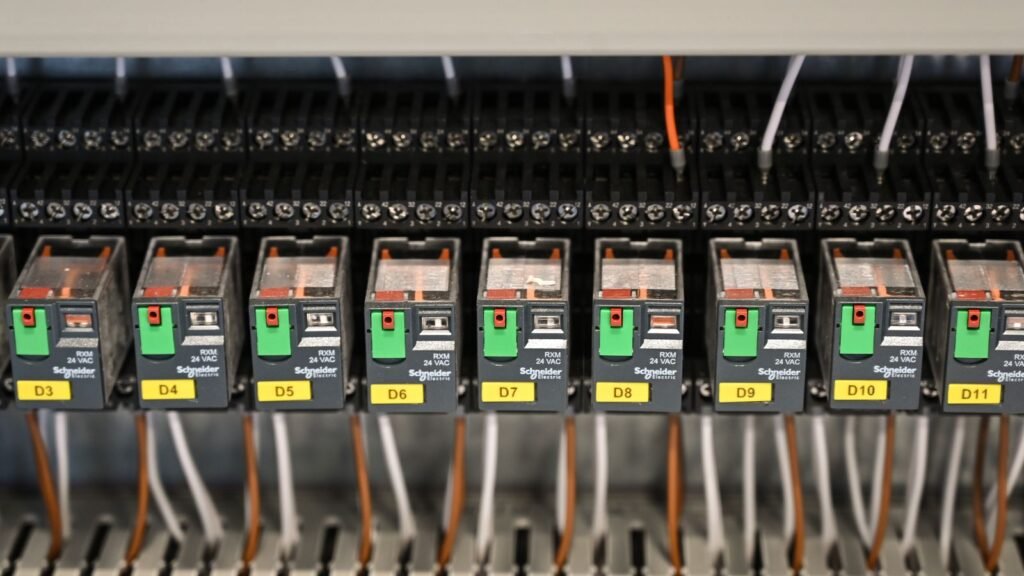
Featured image: “Factory Worker Reading the Manual” by Hoang NC / Pexels, used under the Pexels licence. An illustrative industrial inspection photograph, not a Titania or PyXis installation or an endorsement by the depicted person.