
A Modbus RTU network may show every device as connected while the values on a supervisory screen arrive too slowly for useful diagnosis. Adding one more sensor or widening a register block changes the scan workload, even if the serial settings remain unchanged. A Modbus RTU polling budget makes that workload explicit before an integrator promises an alarm response or a condition-monitoring trend interval.
For a mixed installation involving Titania remote I/O and PyXis vibration monitoring, distinguish the electrical network, each device’s documented data model and the PLC or gateway’s own polling schedule. Neither a successful test read nor a stated baud rate proves the complete system’s worst-case data age.
Budget complete transactions, not just register bytes
On a half-duplex RTU segment, a master sends a request, the addressed slave processes it and returns a response. The next transaction must respect the serial-line framing rules. Each cycle therefore includes request transmission, response transmission, turnaround, the required quiet intervals, device processing and any master or gateway overhead. Errors and retries increase the time further.
Start with the actual serial format because parity and stop-bit choices affect the number of bits transmitted per character. Calculate theoretical transmission time from frame length and baud rate, then measure the complete request-to-valid-response time with the installed controller. Do not replace a measurement with a generic “typical response time” taken from an unrelated device or firmware.
Match every read to a controlled register map
Read-only status, measurements, configuration and identity may reside in different Modbus register classes. A register reference such as 3xxxx or 4xxxx is not itself the protocol address expected by every PLC driver. Check the zero-based offset convention, function code, data width, word order and permitted contiguous block against the released firmware-specific register map.
The Titania RTU commissioning guide and PyXis RTU commissioning guide cover the device setup checks. Neither product name alone authorises an assumed register enumeration, polling frequency or feature on every firmware revision. Record the actual device identity before enabling automated queries.
Separate fast status from slower trend and inventory reads
Group the proposed reads by the decision they support. A machine-state indication may need a tighter project-defined freshness target than a historical vibration trend. Device identity and manufacturing information are normally useful during commissioning or maintenance, not on every control scan. Removing unnecessary repeated inventory reads can free bus capacity for operational values without sacrificing traceability.
Define three quantities for each data group: the intended request interval, the maximum acceptable value age and the action when that age is exceeded. Make the stale condition visible in the PLC and HMI, rather than leaving a last-known value coloured green. An ordinary Modbus monitoring link must not be presented as a certified safety channel; safety-related functions require separately validated architecture.
Allow for faults without one device monopolising the bus
A healthy segment and a segment with one non-responding slave have very different scan times. A long timeout repeated several times can delay all following addresses. Use bounded, justified retry settings; distinguish a communications fault from a legitimate process alarm; and record how the master schedules further polls after a failure. Do not mask repeated CRC faults by indefinitely extending timeouts.
Before changing software, check the physical RS-485 topology, termination, biasing and reference arrangements against the released wiring plan. Duplicate addresses, incorrect serial framing, cable faults and equipment interference can all produce intermittent responses. Diagnose each cause rather than compensating for an unstable link with an oversized budget.
Commission the poll schedule under real load
- Inventory every node, hardware and firmware revision, serial setting and approved register-map issue.
- List the necessary function codes and read groups with their intended freshness and stale-state behaviour.
- Measure request, response, timeout and retry behaviour using the production PLC or gateway.
- Run normal polling with every intended device connected; record cycle distribution, not just the fastest cycle.
- Induce an authorised communications interruption and verify stale flags, alarm handling and orderly recovery.
- Repeat after adding a node, changing a register block or changing firmware, then update the acceptance record.
A useful evidence sheet identifies the asset and slave address, data group, required age limit, measured normal and faulted cycle, timeout policy, PLC tag and witness. For identity discipline before a map change, follow the Titania device identity guide. The correct result is a defensible worst-case design decision, not an impressive isolated laptop poll.
Handover a maintainable communication budget
Archive the as-built node list, controller configuration, measured network loading, source document revisions and any accepted limits. When future work adds a sensor, output module or gateway, the engineer should be able to update this budget rather than guessing why trends have slowed. For an application-specific review, contact Tachyonic Intelligence with the controller model, network topology, firmware list, required values and acceptable data age.
Technical basis: Modbus Serial Line Specification and Implementation Guide V1.02; Titania 8DI/8DO TTN-DS-2026-001 Rev 08 and PyXis 222x TTN-DS-2026-002 Rev 08, issued 22 July 2026. Validate exact capabilities and register addresses using the released maps for installed firmware; the article states no device-specific poll rate or certification.
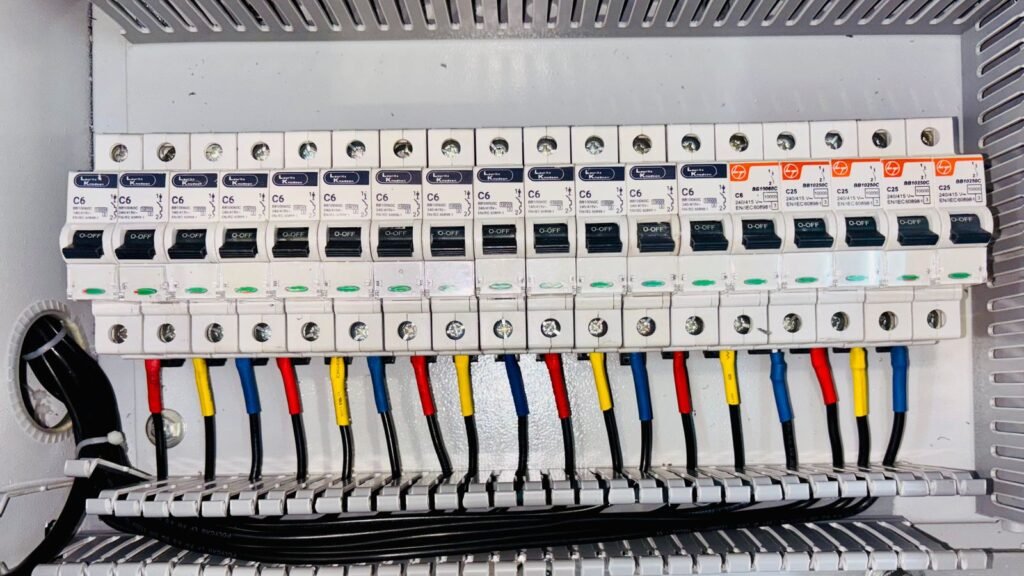
Image credit and disclaimer: Industrial relay-panel photograph by Vladimir Srajber via Pexels, used under the Pexels licence. It depicts generic control equipment, not a Titania or PyXis installation or a measured Modbus result, and does not imply endorsement.