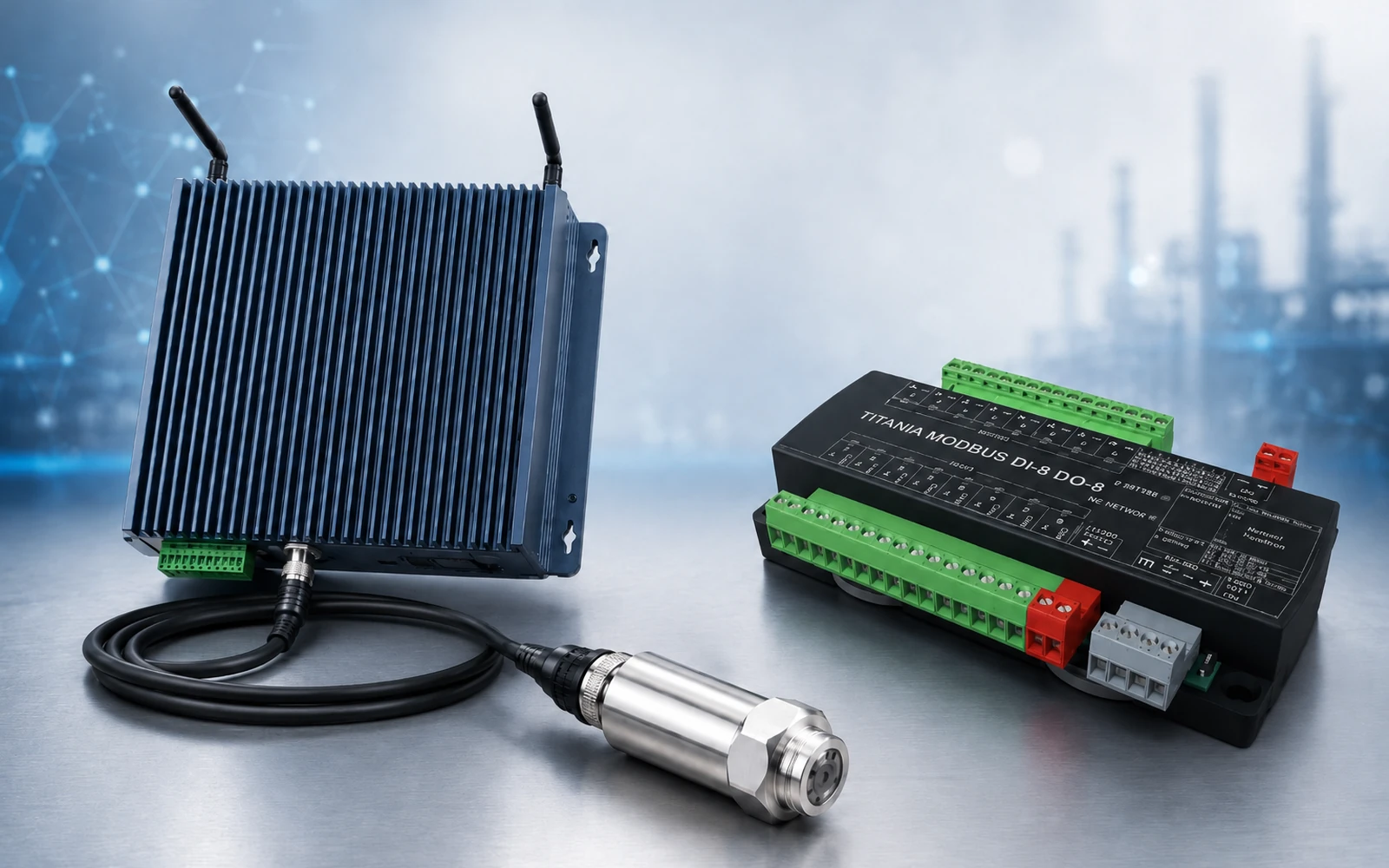

Short answer: for a Titania proportional solenoid PWM application, some 24 VDC raw coils can be connected directly to the Titania Modbus DI-8 DO-8 high-side output, but only after the exact coil is screened for current, manufacturer PWM/dither frequency, control resolution, thermal loading and the required process accuracy. A coil being “24 V” is not enough.
What changed in the current engineering basis: Titania TTN-DS-2026-001 Rev 09 expands and clarifies the PWM operating ranges, effective duty resolution, current limits and accuracy guidance. The controlled solenoid register now separates electrical direct-drive suitability from PWM-frequency qualification, which prevents a low-current coil from being treated as compatible when its required dither frequency is unknown or outside the qualified mode.
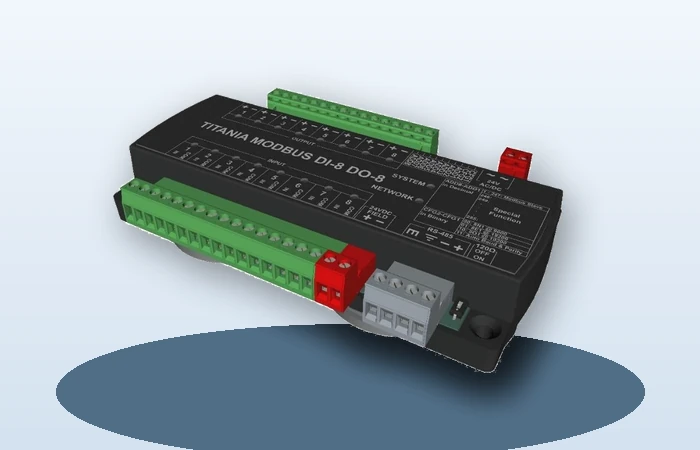
Titania proportional solenoid PWM: the Rev 09 operating modes
The updated engineering data distinguishes four practical PWM-frequency regions. This matters because frequency and effective duty resolution trade against each other: a mode suitable for a heater or slow thermal actuator is not automatically suitable for a proportional valve that specifies hundreds of hertz of dither.
| Mode | Frequency range | Effective duty resolution | Suggested electrical duty accuracy | Typical use |
|---|---|---|---|---|
| SC — slow control | 0.1–10 Hz | 0.1% | ±0.5% target | Heaters, thermal actuators and time-proportioning loads |
| PW — precision PWM | 10–100 Hz | 0.5% | ±1% target | Compatible low-frequency coils and general industrial PWM |
| PS — proportional solenoid | 70–400 Hz | 1–2% | ±2–3% after calibration | Published proportional-solenoid PWM/dither bands |
| EX — extended evaluation | 400–1000 Hz | 2–5% or worse | No precision claim | Engineering evaluation only where the load requires higher frequency |
The controlled Rev 09 datasheet describes 0.1–400 Hz as the qualified PWM range and 400–1000 Hz as an extended range without a precision claim. For a proportional valve, use the manufacturer’s published frequency band first; do not choose a convenient frequency merely because the output can switch at it.
Current rating: the protection threshold is not the load rating
Titania provides eight isolated high-side sourcing outputs. The current engineering data states less than 0.7 A continuous per channel, while simultaneous-channel loading still requires assessment of the PCB, enclosure, ambient temperature and thermal derating. The output-current-limit threshold is a protection function and must not be treated as a continuous operating target.
For screening purposes, the controlled direct-drive register uses three practical classes:
- D1 — preferred direct: normally at or below 0.50 A with suitable voltage and useful design margin.
- D2 — current/duty limited: electrically direct, but the application requires a calibrated current or duty ceiling.
- D3 — near-limit direct: above 0.50 A but below 0.70 A, requiring stronger single-channel and simultaneous-channel thermal validation.
Inrush, coil resistance tolerance, cable voltage drop, field-supply tolerance and enclosure temperature must be considered together. A 0.60 A coil is not the same engineering case as a 0.30 A coil even when both are nominally 24 VDC.
What the controlled solenoid register says today
The current frequency-qualified register contains 146 exact part numbers/model configurations across 16 electrically verified manufacturers. Electrical screening and frequency qualification are tracked separately:
- 33 exact configurations have published frequencies compatible with the standard Titania modes;
- 3 are conditional;
- 19 require the extended-frequency evaluation region; and
- 91 remain pending because a numerical manufacturer PWM/dither frequency has not been established.
That distinction is important. An electrically suitable raw coil is not automatically a frequency-qualified proportional-solenoid application.
Examples of frequency-qualified 24 V proportional-solenoid loads
The examples below are register-screened engineering candidates, not unconditional approvals. Production use still requires the exact delivered part, actual Titania hardware/firmware, thermal conditions, cable and simultaneous-output loading to be tested.
| Manufacturer / exact part | Published current | Published PWM / dither | Register class | Titania qualification point |
|---|---|---|---|---|
| Bürkert 275060, Type 2863 | 0.42 A | 300–400 Hz | D1 — preferred direct | 350 Hz; 2% effective duty resolution |
| HydraForce TS10-36A-0-N-24DG | 0.55 A | 200 Hz | D3 — near-limit direct | 200 Hz; 1% effective duty resolution; thermal validation required |
| HOYEA HY-EHPR08-33, 24 V coil | 0.60 A | 200 Hz dither | D3 — near-limit direct | 200 Hz; 1% effective duty resolution; near current boundary |
The register currently contains 20 published-frequency-compatible Bürkert configurations, 12 HydraForce TS10-36 configurations and one HOYEA configuration. Other electrically screened parts may still be awaiting an exact numerical PWM/dither specification, or may require a frequency above the standard proportional-solenoid mode.
Five gates before connecting a proportional solenoid directly
1. Confirm that it is a raw coil
Direct PWM applies to an accessible raw proportional coil. Devices with integrated 0–10 V, 4–20 mA, IO-Link, CANopen or proprietary electronic drivers should use their specified command interface rather than being treated as a bare coil.
2. Confirm current at the exact order code
Use the manufacturer’s full-scale or maximum coil current for the exact voltage and connector option. Do not infer current from a family name, nominal voltage or a visually similar valve.
3. Match the manufacturer’s PWM/dither frequency
Where the manufacturer publishes a band, keep the qualification point inside that band. Where no numerical frequency is published, treat the application as pending until the manufacturer supplies it or a controlled bench test establishes it.
4. Decide whether the available resolution and accuracy are sufficient
A process requiring fine low-flow control may be more sensitive to duty-step size, timing bias and coil heating than an application that only needs broad proportional positioning. Validate the complete valve response, not only the electrical duty command.
5. Test worst-case thermal loading
Validate minimum and maximum field voltage, coil tolerance, cable length, ambient temperature, enclosure conditions and the worst credible number of simultaneously energised outputs. Near-limit D3 loads deserve particular attention.
When an external proportional driver is the better choice
Use an external amplifier, dedicated current controller or the valve manufacturer’s electronics when the load exceeds Titania’s output-current envelope, requires tightly regulated coil current, needs a high PWM/dither frequency outside the qualified range, includes integrated electronics, or has accuracy requirements that cannot be demonstrated with direct voltage PWM.
Direct drive is valuable when it simplifies the panel without compromising control quality. It should not be used simply to eliminate one component from the BOM.
Use the live Titania PWM Solenoid Compatibility Checker
Tachyonic Intelligence provides a browser-based engineering checker that searches the controlled exact-part register and screens a new raw coil using current, frequency, duty-step, accuracy and timing-bias limits.
Screen an exact solenoid before you design the panel
Search the part number or enter the electrical and control-quality requirements. The tool keeps electrical direct-drive status separate from PWM-frequency qualification.
You can also use the Tachyonic product selector to combine PWM requirements with I/O count, communications and other system constraints.
Request a Titania proportional-solenoid application assessment
For an engineering review, send the exact valve/solenoid manufacturer and part number, coil voltage, maximum or full-scale current, published PWM/dither frequency, required control range, simultaneous active channels, cable length, ambient/enclosure conditions, PLC or SCADA platform, quantity and target date.
Request a Titania proportional-solenoid application assessment or contact Tachyonic Intelligence at inquiry@tachyonicintelligence.com or +60 12-681 0921.
Source and technical fact-check
- Titania 8DI/8DO Industrial Super I/O datasheet TTN-DS-2026-001 Rev 09, issue date 25 July 2026. Rev 09 specifically updates PWM frequency ranges, effective resolution, current limits and accuracy guidance.
- Titania Direct-Drive Solenoids Frequency Master Register, 146 exact electrically screened configurations across 16 verified manufacturers, with electrical status and frequency status tracked separately.
- Titania PWM Solenoid Compatibility Checker and Titania product page, checked 12 September 2026.
Fact-check note: Register inclusion is an engineering screening result, not an unconditional product approval. Production approval requires exact-part testing on the installed Titania hardware/firmware at the required supply voltage, temperature, cable and simultaneous-channel conditions. Safety-related functions require a separately designed and validated safety system.