
PyXis motor monitoring is best planned around the motor’s mechanical condition, operating pattern and role in the process. For a first deployment, start with production-critical industrial induction motors that run for sustained periods, have accessible rigid mounting points near the bearings and can be measured under repeatable speed and load conditions.
Variable-speed induction motors and industrial synchronous motors are also worth assessing, but their operating context needs more attention. DC motors, servo axes and stepper-driven mechanisms should be reviewed individually before selecting the sensor or promising a particular diagnosis.
These are engineering recommendations for selecting monitoring candidates. The controlled PyXis 222x Series Rev 08 datasheet lists electric motors as a typical application; it does not provide a blanket approval list by motor technology, manufacturer, frame size or power rating.
Induction motors are the first shortlist
Fixed-speed industrial induction motors with rolling-element bearings are a practical starting point when the objective is to trend housing vibration and temperature. Choose motors for which a deterioration trend would lead to a defined inspection or maintenance action, especially where loss of the driven process would be difficult to manage.
The bearing arrangement is relevant to the measurement. SKF’s electric-motor monitoring application note explains the use of acceleration-based bearing information alongside velocity-based rotational information on motors with rolling-element bearings. That supports the general monitoring rationale; it does not establish PyXis compatibility or transfer SKF diagnostic performance to this product.
A pump motor, fan motor or conveyor motor is still a motor type plus an application. A centrifugal pump is the driven equipment, while induction describes the motor technology. Record both. The motor’s condition and the load’s condition may need separate measurement points rather than assuming one housing measurement represents the complete train.
Motor types and the assessment each needs
| Motor category | Recommended selection approach | Checks before release |
|---|---|---|
| Fixed-speed industrial induction motor | First shortlist for sustained-duty mechanical condition trending | Bearing arrangement, rigid mounting, representative load and a repeatable healthy baseline |
| Variable-speed induction motor | Candidate when speed and operating state can be recorded reliably | Actual speed range, RPM/data-quality validation, filter settings and comparable speed/load states |
| Industrial synchronous motor | Assess for housing-vibration and thermal trending | Bearing and shaft arrangement, speed, mounting path and the required diagnostic scope |
| DC motor | Individual assessment for mechanical monitoring | Duty cycle, bearing access, speed and separate requirements for electrical or commutation assessment |
| Servo or stepper motor | Individual feasibility review before inclusion in a general motor-monitoring programme | Motion cycle, stable measurement periods, structural vibration, firmware update timing and the target fault mechanism |
The table ranks selection work rather than declaring every motor in a category compatible. ABB’s own condition-monitoring documentation includes induction and synchronous AC motors, fixed and variable speed, and continuous and intermittent duty. This provides industry context for those categories, not a specification for PyXis. The actual PyXis installation still needs to pass the product’s mounting, environmental and firmware checks.
Variable-speed motors need comparable operating states
A VFD-driven motor should not be excluded simply because its speed changes. However, a trend taken at one speed and load should not automatically be compared with a reading taken at another. The PyXis datasheet explicitly makes fault interpretation dependent on speed, load, mounting, geometry, baseline quality and firmware profile.
PyXis documents RPM, tachometer quality, speed state and 1X order information for speed-referenced interpretation. Validate those outputs across the operating range on the delivered firmware. Treat an invalid or uncertain speed estimate as a data-quality exception rather than feeding it silently into an alarm decision.
Capture healthy operation at the normal operating states and retain the machine profile and filter settings with that baseline. The PyXis machine-profile configuration guide covers motor frequency, gear ratio, tooth count and bearing geometry. Motor supply frequency and mechanical running speed should be recorded according to their documented meanings, rather than entered interchangeably.
DC, servo and stepper motors need a narrower brief
For these categories, first write down what the monitoring must reveal. A requirement to track repeatable mechanical vibration is different from a requirement to diagnose an electrical, commutation or motion-control problem. The Rev 08 datasheet does not establish motor-type-specific diagnostic coverage for DC, servo or stepper motors.
Ask for a feasibility review that includes the operating cycle, speed range, available mounting point and expected measurement window. The PyXis sample and update timing depends on the firmware profile and enabled analysis functions. Confirm that timing before planning monitoring around short motion cycles or transient events.
Similarly, motors with sleeve bearings, inaccessible housings or unusual shaft arrangements need an application review. Do not apply rolling-element bearing geometry settings to a different bearing arrangement or infer that housing vibration supplies every measurement the maintenance plan requires.
Use the documented measurements for the right purpose
PyXis provides independent X, Y and Z acceleration, velocity and displacement metrics, harmonic frequency/amplitude arrays, and per-axis condition information. Temperature data can support correlation with vibration trends. Advanced diagnostic and prognostic outputs depend on the firmware profile and should be qualified separately.
Internal sensor temperature is not proof of motor winding temperature. An additional motor-temperature data point is profile dependent. Likewise, the documented vibration outputs should not be presented as measurements of current, insulation condition, energy consumption or guaranteed detection of a named electrical fault.
The PyXis fault-state integration guide explains how to retain the supporting condition values and data-quality checks alongside alarms. Maintenance decisions should use those records and an inspection workflow, rather than a status word alone.
Prioritise the motor, then qualify the installation
Select motors according to the consequence of interruption, available standby capacity, access for inspection and the action the maintenance team can take. There is no documented universal minimum motor power or speed in the controlled source used here, so an arbitrary kW threshold should not decide the shortlist.
For every selected motor, confirm a clean, rigid mounting location near the bearing or structural load path, record axis orientation and keep the same location and mounting method for trend comparison. The PyXis mounting guide explains the M5 stud and magnetic-base options. Validate environmental limits, cabling, firmware and the released register map before commissioning.
Start with a small set of important motors whose operating conditions can be recorded well. Release the monitoring point after communication, speed quality, baseline repeatability and alarm behaviour have been checked on the actual asset.
Send the motor type, operating-speed range, duty and load pattern, driven equipment, bearing arrangement and mounting constraints for a PyXis monitoring assessment. A nameplate photograph and a view of the proposed mounting area are useful starting information.
Technical basis: PyXis 222x Series datasheet TTN-DS-2026-002, Rev 08, issued 22 July 2026. Detailed integration and diagnostic availability require the matching firmware release note and register map. General monitoring context: SKF electric-motor monitoring application note and ABB motor condition-monitoring datasheet, Rev D, November 2019. Their product capabilities are not claimed for PyXis.
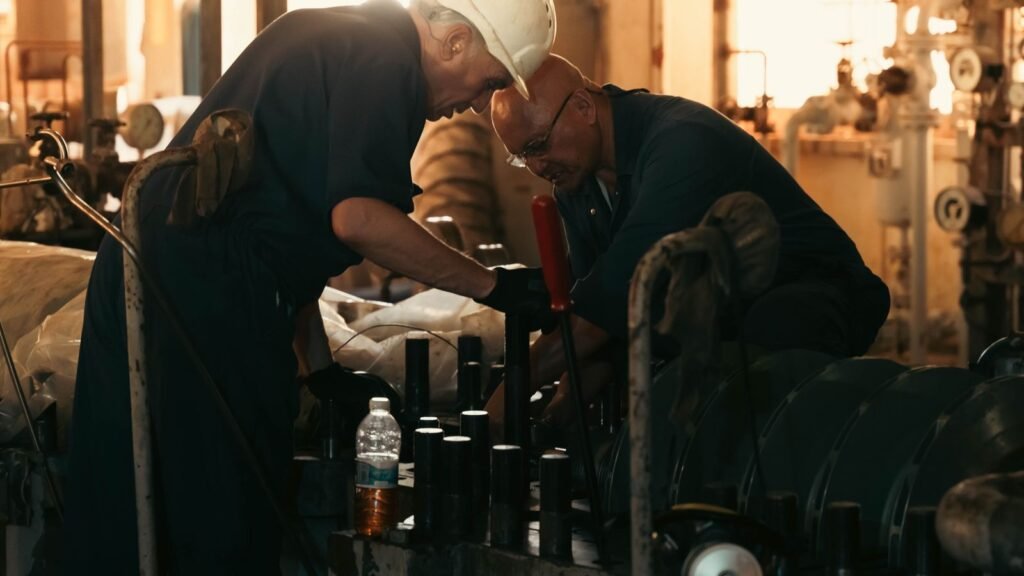
Illustration: AI-generated representation of a large, heavy-duty industrial electric motor driving a process pump. Intended to depict a 750 kW-class installation, not a manufacturer-verified power rating, photographed installation or a fitted PyXis sensor.