
8 isolated digital inputs
Dry contact, PNP and NPN field devices with integrated counters and configurable filtering.
Titania Super I/O வகை
Titania extends field-level digital connectivity through isolated Modbus RTU I/O, local logic and industrial protection for distributed automation.
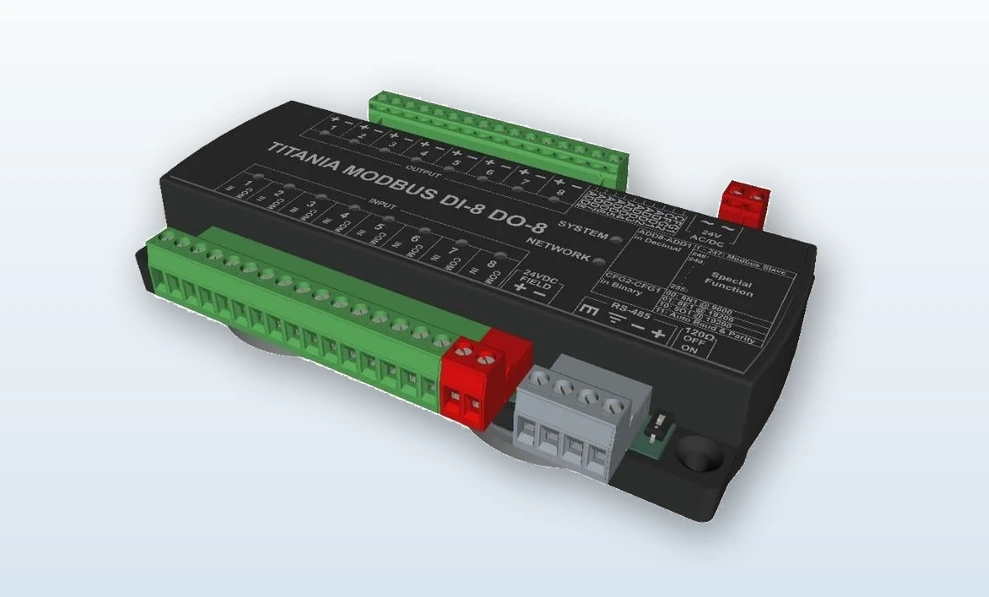
Key capabilities
Titania combines dense I/O, diagnostics and edge functions in a compact DIN-rail module.
Dry contact, PNP and NPN field devices with integrated counters and configurable filtering.
Isolated high-side sourcing outputs for 24 VDC loads, with PWM support and programmable safe values.
Hardware logic, autonomous sequencing, alarm annunciation and local PWM operating modes.
Galvanic isolation, reverse-polarity protection, current limiting, thermal shutdown, ESD, EFT and surge protection.
System, communication and per-channel input/output LED indications support commissioning and troubleshooting.
Configure address, communication and operating mode through DIP switches and Modbus registers.
Configurable operating modes
Confirm final wiring, ratings and applicability against the latest controlled datasheet before installation.
| Mode | Function | Typical use |
|---|---|---|
| Normal Modbus Slave | Standard Modbus RTU operation using a software-configured slave ID from 1 to 247. | Central PLC, RTU, IPC or SCADA monitoring and control. |
| Hardware Logic Gates | Per-output input masks support AND, OR, XOR, NAND, NOR and XNOR relationships. | Local interlocks and deterministic field actions independent of routine host polling. |
| Pattern Matching | Detects a configured 8-bit input pattern with optional polarity inversion for each input. | Machine-state recognition and compact interlock conditions. |
| Programmable Sequencer | Linear or pendulum sequences with channel mask, step interval, pulse width, inter-sequence delay and repeat control. | Valve sequencing, backwash cycles and repetitive machine actions. |
| Alarm Annunciator | Selected inputs drive steady or blinking outputs using active-high or active-low logic and a configurable flash interval. | Local panels, stack lights, sirens and machine alarm functions. |
| PWM / PID Control | Per-channel PWM includes frequency, duty, ramping, hold, minimum and maximum intensity; supported modes add smoothing, noise tolerance and PID auto-tune. | Time-proportional loads, controlled intensity and supported closed-loop applications. |
| Frequency Simulator | Generates triangle, sawtooth, square or sine frequency patterns between configured limits. | Simulation, test and controlled frequency-output applications. |
| Safe-State Controller | Programs every output for power-up and communications-loss conditions. | Deterministic recovery and network-failure behaviour. |
Technical specifications
Confirm final wiring, ratings and applicability against the latest controlled datasheet before installation.
8 channels; dry contact, PNP or NPN; 1 kHz maximum input frequency; 32-bit counter per channel; filter selections from Off and 1 microsecond through 100 milliseconds.
8 isolated high-side sourcing outputs; 0.7 A continuous per channel; approximately 1.1 A peak/current limit; PWM 1-50 Hz at 1% steps.
1 x isolated RS-485, 2-wire half duplex; Modbus RTU; 9600, 19200, 38400 and 115200 baud with auto-baud detection; 8N1, 8N2, 8E1 and 8O1.
24 VDC nominal, 19.2 to 28.8 VDC operating range; 2-3 W system consumption excluding external output loads.
161 x 80 x 20 mm; integrated DIN-rail mounting.
-20 C to +70 C operating; -40 C to +85 C storage; 10-95% RH non-condensing.
ESD IEC 61000-4-2, EFT IEC 61000-4-4 and surge IEC 61000-4-5 protection levels stated in the controlled datasheet.
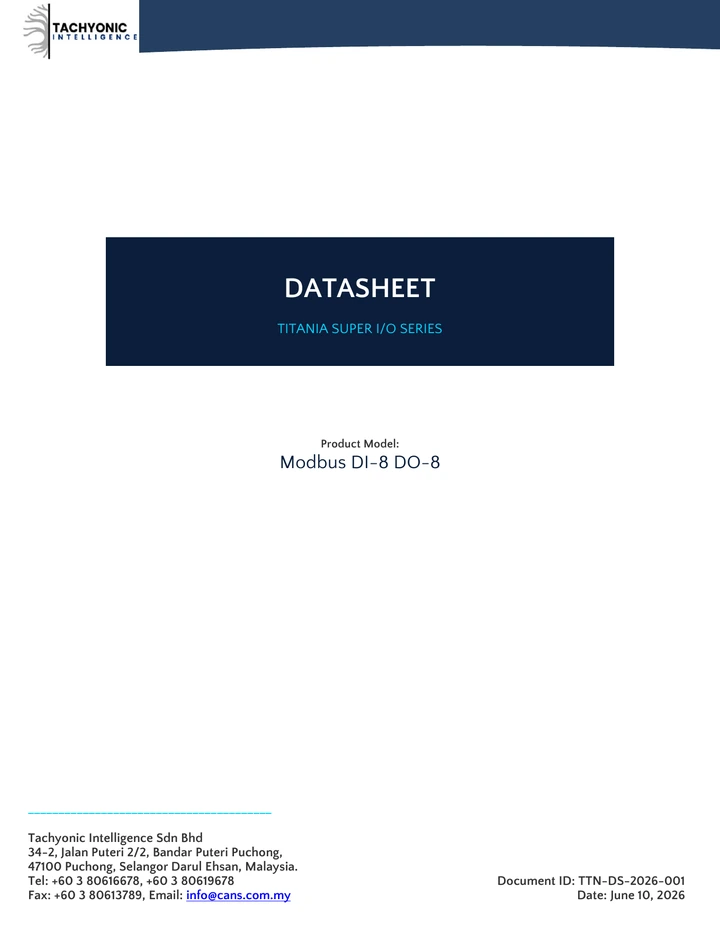
Current controlled document
Document ID TTN-DS-2026-001 · issued 19 July 2026
Confirm final wiring, ratings and applicability against the latest controlled datasheet before installation.
Titania Modbus DI-8 DO-8 combines eight dry-contact, PNP or NPN inputs with eight isolated high-side sourcing outputs. Every input supports a 32-bit counter, edge selection, frequency measurement and configurable filtering up to a documented maximum input frequency of 1 kHz.
The protected outputs support 0.7 A continuous current per channel with all channels active, subject to ambient and thermal conditions, plus current limiting, active-clamp support for inductive loads, PWM and programmable safe values.
Documented modes include normal Modbus slave operation, Boolean logic, pattern matching, programmable sequencing, alarm annunciation, PWM/PID control, frequency simulation and safe-state control. These functions should be applied within a controlled architecture and are not a substitute for certified safety logic.
Technology insights
Practical guidance derived from the current PyXis and Titania technical material.
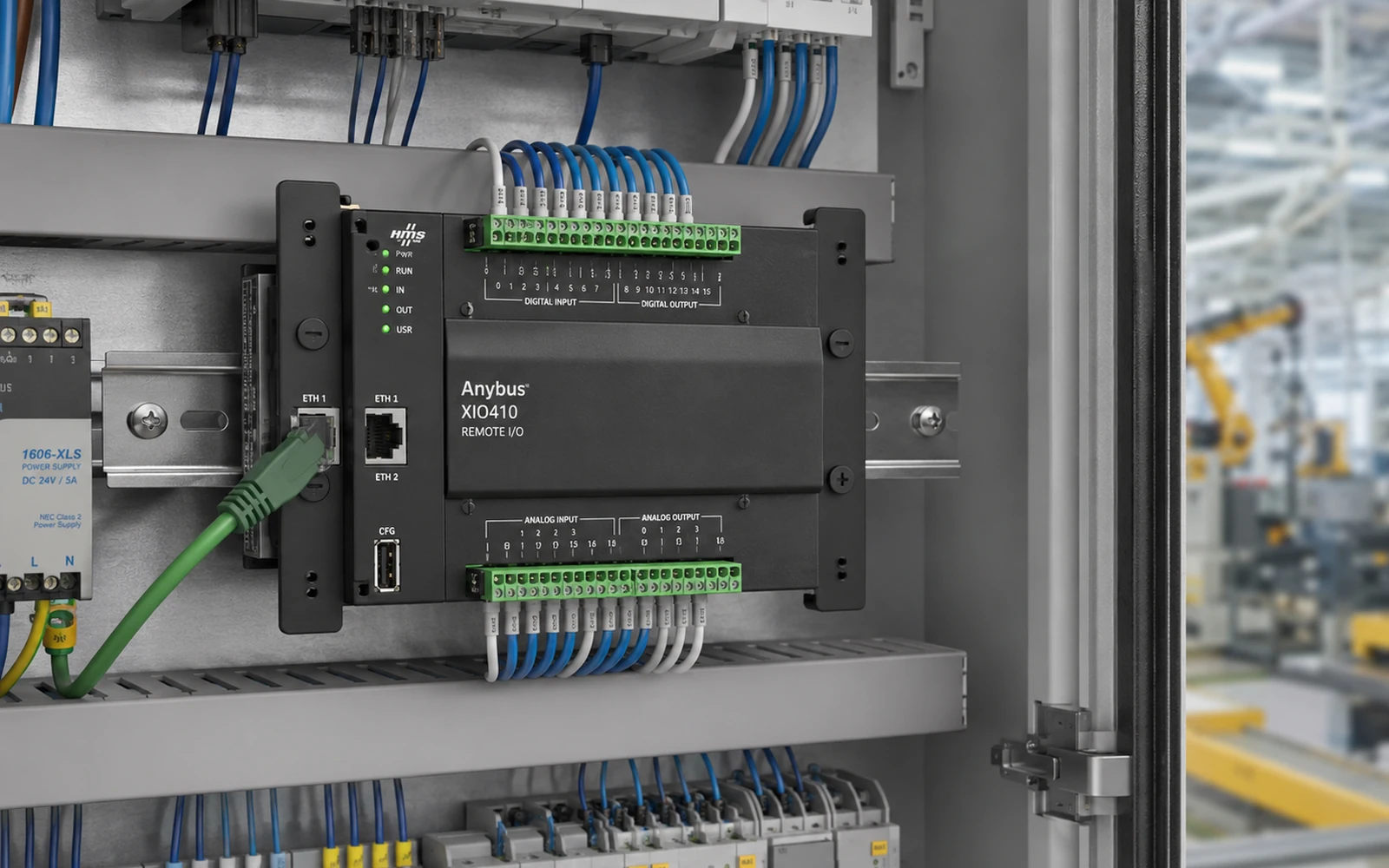
Technology article
Why remote I/O becomes more resilient when it can continue selected logic, sequencing and safe-state functions without the host controller.
Read more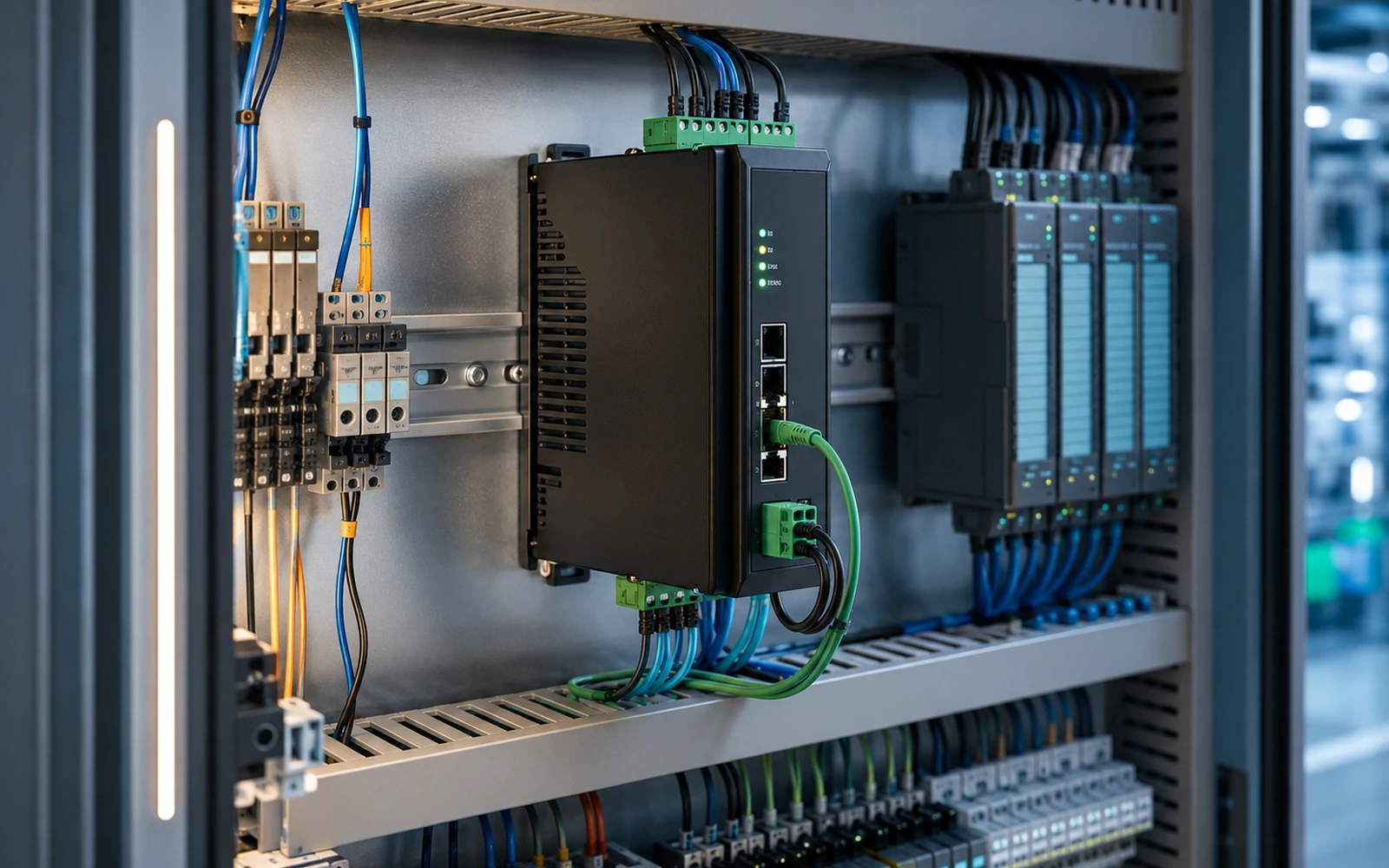
Technology article
How to select the input mode, reference common and filtering for switches and industrial sensors.
Read more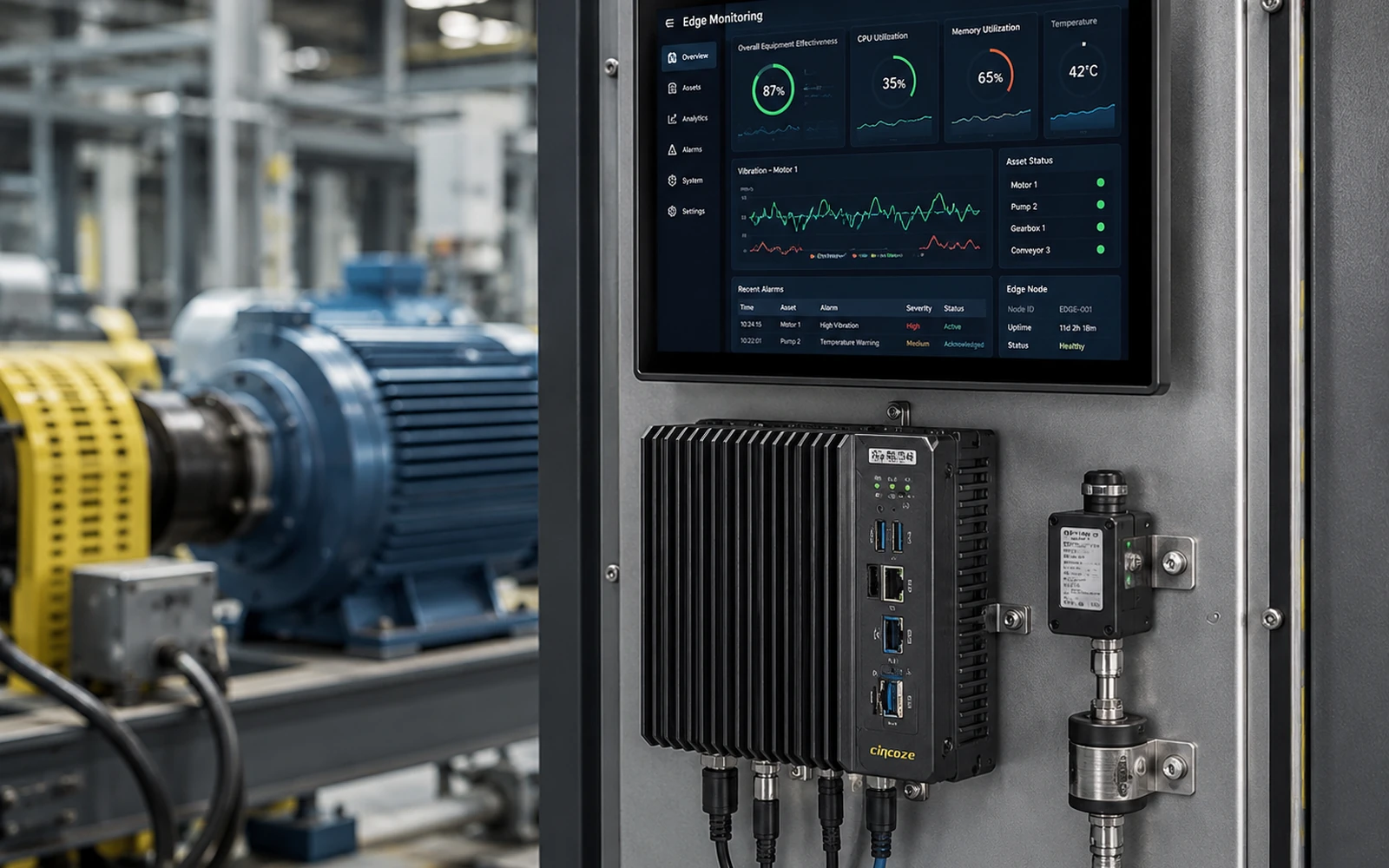
Technology article
Design considerations for 1 kHz digital inputs, 32-bit counters, edge selection and reliable pulse capture.
Read more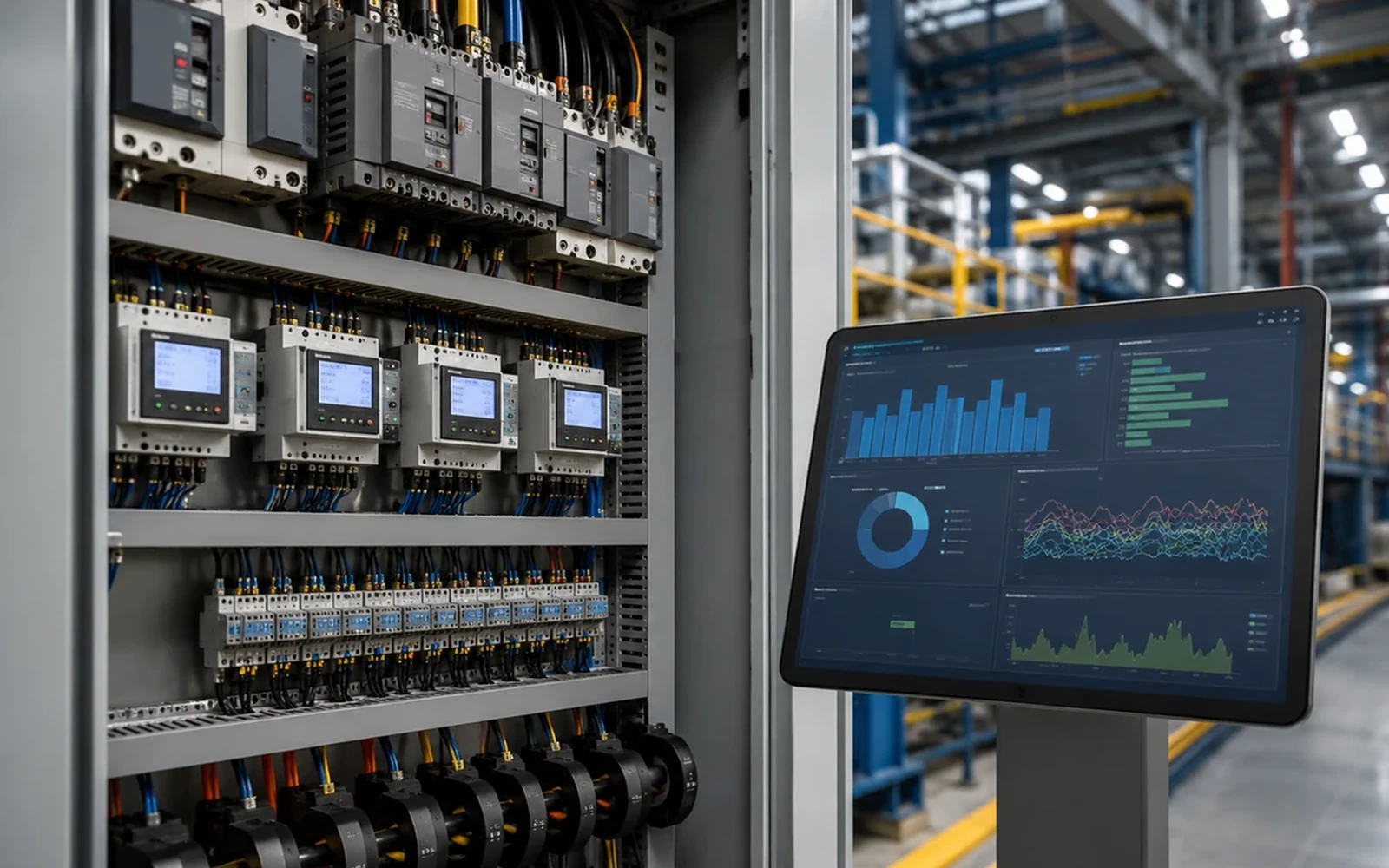
Technology article
How protected 24 VDC sourcing outputs should be applied to solenoids, relays, lamps and other industrial loads.
Read more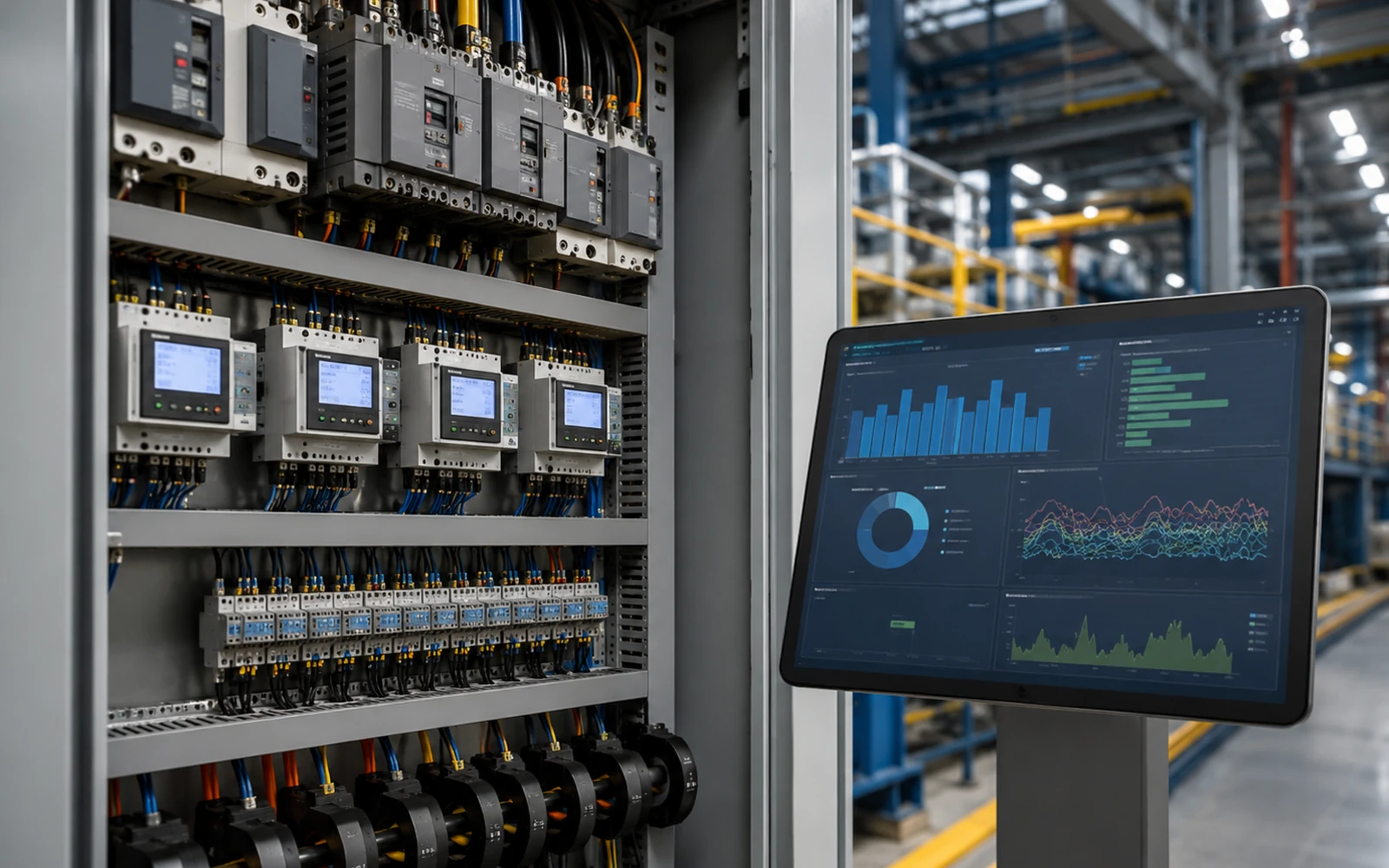
Technology article
How deterministic power-up and communication-loss behaviour improves distributed I/O resilience.
Read more
Technology article
Applying Boolean logic, pattern recognition, timed sequences and annunciation functions within distributed I/O.
Read moreDiscuss your Titania application
Review input type, output loads, local logic, communication, isolation and enclosure requirements with our team.