
A pump motor may show a short vibration increase each time it starts, even when its normal operating trend remains stable. The important engineering question is not whether the transient exists, but whether its magnitude, duration and repeatability are consistent with the machine’s approved operating sequence. Treating every start-up peak as a bearing fault generates nuisance alarms. Ignoring a newly prolonged or abnormal transient can conceal a genuine mechanical or process problem.
Separate acceleration from established operation
During acceleration, motor torque, shaft speed, coupling forces and the driven machine’s process load change together. The assembly may pass through a speed range at which its dynamic response differs from the steady operating point. A direct-on-line start, variable-frequency drive ramp and load-dependent start can therefore produce different vibration histories on the same machine.
Record how the motor is started, whether the machine is loaded, the nominal operating speed and the time taken to reach a stable condition. Do not compare a start-up maximum directly with a steady-running alarm threshold without checking the underlying monitoring specification. A peak alone does not identify a bearing defect, misalignment, looseness or resonance.
What the monitoring system should retain
Useful evidence combines a correctly mounted vibration sensor with process context. At minimum, capture the start command or run-status transition, the observed acceleration period, relevant motor speed or drive frequency when available, load conditions, and the time at which the reading becomes representative of steady operation.
PyXis can support condition monitoring when its available measurements, sampling and reporting behaviour are matched to the actual installed model and firmware. The PyXis sensor-mounting guide explains why a repeatable mounting position and axis orientation matter. An overall value reported over a defined acquisition interval cannot automatically be interpreted as an instantaneous peak: confirm the measurement definition and update timing in the firmware-specific register map.
A practical start-up acceptance sequence
- Establish a safe test. Follow the plant’s authorised start-up procedure and maintain all guards and protective functions. Confirm the test can be completed without exposing personnel to rotating machinery.
- Identify the start mode. Note direct-on-line, soft-starter or variable-speed-drive operation, configured ramp and the state of the driven equipment. Record any process conditions that affect starting load.
- Capture the operating timeline. Use controller timestamps for command, actual running indication and any speed or process feedback. Preserve communication-quality indicators rather than treating an unchanged tag as proof of a stable machine.
- Observe the vibration response. Record raw or suitably qualified trend values during start-up and after stabilisation, respecting the measurement update interval. Compare the same sensor position, axis, filter settings and units.
- Repeat under controlled conditions. Where operationally permitted, compare several comparable starts. Note changes in ambient temperature, initial load and time since the last stop rather than forcing dissimilar starts into one reference.
- Document exceptions. Investigate a new peak, lengthened settling time, unexpected speed dependence, trip or sustained elevated vibration. Escalate significant changes for appropriate mechanical and electrical examination.
The acceptance record should show which results describe acceleration and which represent a repeatable steady state. If measurements are available only at relatively slow reporting intervals, state that limitation openly instead of claiming to resolve short transients that the system may not capture.
Design alarms around the actual machine duty
Alarm suppression or a commissioning delay may be appropriate for an explicitly approved start-up state, but it must not silently disable machine protection. Define the transition into and out of that state using validated signals, maximum permitted duration, a clear fallback on missing feedback and the plant’s risk assessment.
Where a PLC or SCADA system performs supervisory monitoring, keep its quality and state logic distinct from independent protective systems. The motor vibration and temperature trend guide discusses operating-context comparisons. Never assume a universal permissible start-up amplitude or delay; acceptance criteria depend on machine design, duty, measurement type and documented operating limits.
Handover: make the comparison reproducible
Retain the machine asset identifier, controller and drive configuration, sensor identity and mounting, installed firmware, register-map revision, capture interval, time synchronisation method, recorded starts and interpretation. Verify that the PLC does not report stale values as current during the start sequence or after a communications interruption.
For a PyXis integration review, provide the motor and driven-machine particulars, starter or drive configuration, duty cycle and available trend captures through Tachyonic Intelligence’s contact page. The aim is a defensible start-up reference, not a diagnosis based on one unexplained number.
Technical references: PyXis 222x Series controlled datasheet TTN-DS-2026-002 Rev 08 (site-hosted, issued July 2026); Modbus Application Protocol Specification V1.1b3 for data transport context. Verify supported measurements, scaling and timing against the installed firmware’s released register map. No device-specific address, transient capture rate, alarm limit or certification is claimed.
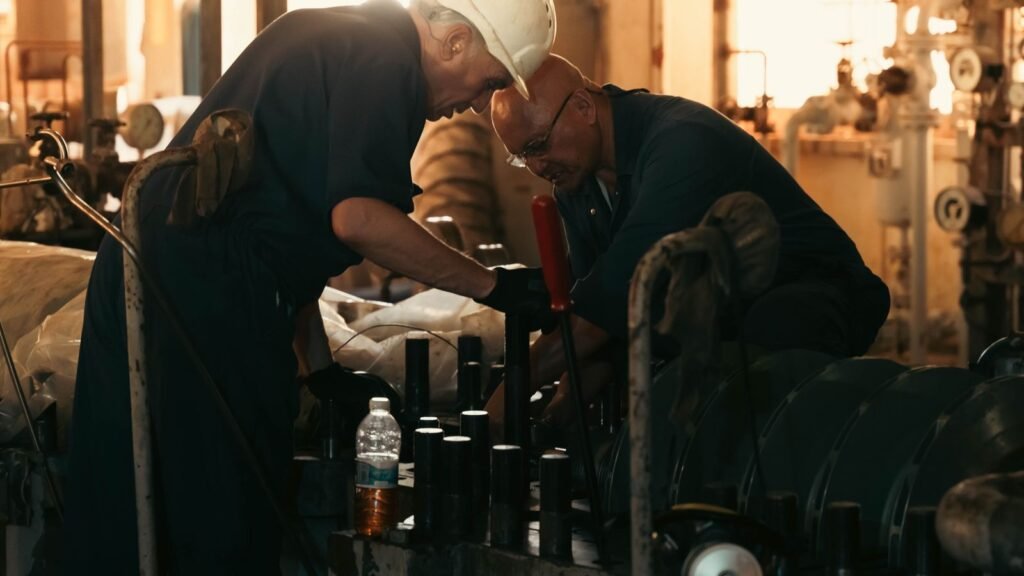
Image credit and disclaimer: “Industrial Worker Using Tablet in Factory”, Sergey Sergeev / Pexels, reused from TISB’s authorised media library under the Pexels licence. Generic illustrative scene; not a depicted PyXis installation, measured start-up test or product endorsement.