
For manufacturing engineers, quality managers and automation buyers, the expensive AI vision problem is rarely the demonstration. It is making inspection repeatably work at production speed—and ensuring the decision reaches the machine correctly.
FUJIFILM Business Innovation Malaysia has scheduled a manufacturing showcase in Johor Bahru for 3 September 2026, featuring AI vision for compliance, workplace safety and productivity. The event is a useful local demand signal: Malaysian manufacturers are actively evaluating where vision AI belongs in real operations, not only in laboratory trials. View the official event page.
Planning an AI vision inspection station? Tachyonic can help define the industrial I/O, PLC handshake, non-safety outputs and integration scope around the vision system. Request an industrial I/O application assessment.
Why a good AI model is not yet a production inspection system
A vision model may classify sample images accurately and still fail on the line. Production introduces changing illumination, part-position variation, vibration, contamination, motion blur, product changeovers and incomplete communications between the camera, controller and reject mechanism.
NIST’s current AI-for-manufacturing programme focuses on fit-for-purpose selection, reliable and interoperable data infrastructure, system-integration effort, performance, semantic correctness and traceability. That framing is useful for buyers: inspection performance must be assessed as a complete operating system, not as an isolated model score. See the NIST manufacturing-AI programme.
Eight questions to answer before requesting quotations
1. What defect or condition must be detected?
Describe the decision in physical terms: missing component, incorrect orientation, surface scratch, fill level, print quality, dimensional tolerance, foreign object or operator-compliance event. Define which variations are acceptable and retain representative good and bad samples.
A broad request such as “use AI for quality” does not give a supplier enough information to select optics, resolution, lighting or a validation method.
2. Can the feature be made visible consistently?
Lighting geometry often determines whether the relevant feature appears with stable contrast. Backlighting can emphasise silhouettes; dark-field lighting can reveal surface irregularities; diffuse or dome lighting can reduce reflections on curved parts. The lighting, wavelength, lens, camera position and part presentation should be designed together.
The Association for Advancing Automation notes that uncontrolled ambient lighting and oversaturation can remove the image detail that inspection algorithms need. Review its machine-vision lighting guide.
3. What triggers each image?
The system may use a photoelectric sensor, encoder position, PLC event or software trigger. Trigger polarity, debounce, minimum spacing and line speed matter. Camera documentation also warns that frames can be ignored or dropped when the trigger rate exceeds the camera, data-transfer or storage capacity. See Basler’s triggered-acquisition documentation.
4. What is the available inspection time?
Cycle time must include exposure, image transfer, inference, decision communication and the mechanical delay before the reject point. Specify the fastest production rate and the permitted latency—not only the average rate.
5. How will the vision station exchange status with the PLC?
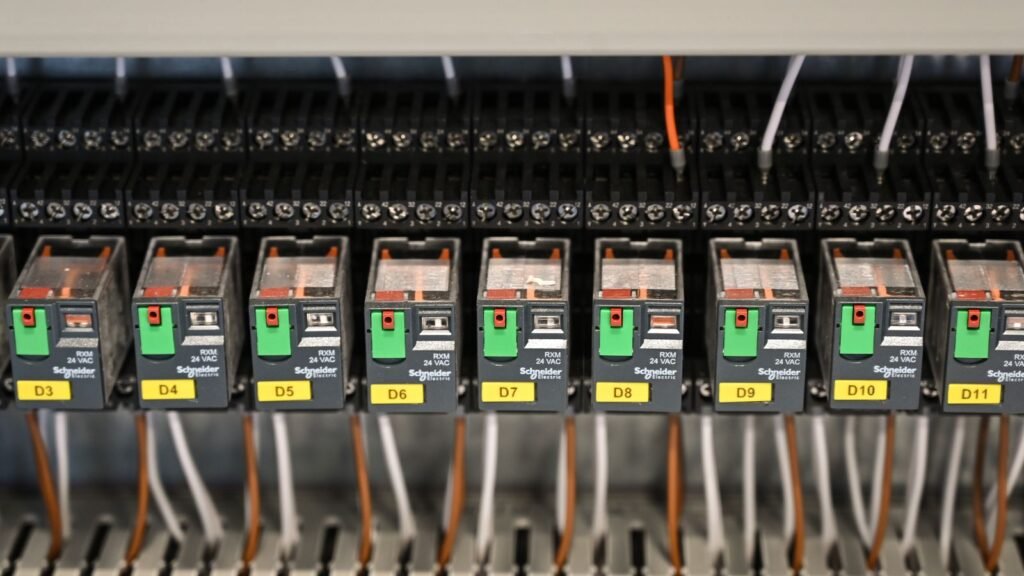
Define the handshake explicitly. Typical application-dependent signals may include part present, capture request, inspection busy, result valid, pass/fail, fault, recipe selected and reset acknowledgement. The design must also define whether each signal is a dry contact, PNP/NPN sensor, 24 V digital signal, pulse, serial register or network value.
For suitable non-safety functions, industrial remote I/O can collect line-state signals, counts and status near the machine and exchange them with a PLC or supervisory system. Tachyonic’s Titania Super I/O family provides isolated field inputs, protected outputs, pulse measurement, Modbus RTU and selected local edge-control functions. Final electrical and timing suitability must be checked against the controlled product documentation and the actual machine design.
6. How is a reject physically confirmed?
A software “fail” result does not prove that the defective part left the good-product stream. A robust design may need an application-appropriate reject command, actuator monitoring, downstream confirmation, bin-full detection, air-pressure status and an alarm or line-stop rule when confirmation is missing.
Mid-project checklist: document camera trigger, result-valid timing, pass/fail encoding, reject output, reject confirmation, fault reset, communications-loss behaviour and ownership of each alarm. Share the signal list for an I/O architecture review.
7. What happens when the camera, model or network fails?
Specify behaviour for camera offline, invalid image, uncertain result, model service unavailable, communications timeout, power interruption and recipe mismatch. A defined fault state is safer and easier to troubleshoot than treating missing data as a pass.
8. How will performance be validated and maintained?
Agree on representative samples, production conditions and acceptance metrics. Track false accepts and false rejects separately. Keep image and decision records appropriate to the process, control model and recipe revisions, and retest after changes to lighting, optics, product presentation or software.
Keep AI inspection separate from machine-safety claims
An AI camera used for quality inspection or operational awareness should not automatically be treated as a safety-rated protective device. If a vision function affects personnel protection, the complete safety-related control function must be engineered and validated to the applicable risk assessment, architecture and standards. ISO 13849-1:2023 sets general design principles for safety-related parts of machine control systems; using AI elsewhere in the system does not remove those obligations. View the ISO standard record.
Where Titania fits—and where it does not
Titania is not presented as an AI camera, vision model or safety controller. Its genuine role is the industrial field-I/O layer in an appropriately engineered architecture: acquiring compatible digital or pulse signals, providing protected outputs for suitable non-safety loads, exchanging data over Modbus RTU and supporting selected local behaviours.
That layer matters because the inspection decision only creates value when it is synchronised with the correct part, communicated reliably, confirmed mechanically and made visible to operators and maintenance teams.
A practical pilot specification
- Product and defect classes, with representative samples
- Line speed, cycle-time range and changeover conditions
- Lighting, optics, camera position and environmental constraints
- Trigger source and timing budget
- Required PLC or IPC handshake and protocol
- Signal types, I/O count and output loads
- Reject mechanism and confirmation method
- Fault, reset and communications-loss behaviour
- False-accept and false-reject acceptance criteria
- Quantity, installation location and target date
Use Tachyonic’s product selector to review published I/O options, or explore the company’s industrial automation and integration approach.
Request an industrial I/O application assessment
Send your company and industry, product or process, inspection objective, current PLC or IPC, protocol, signal types, I/O count, output loads, cycle time, installation environment, quantity and target date. Tachyonic can help determine the I/O and integration questions that should be resolved before procurement.
Sources and fact-check note
- FUJIFILM Business Innovation Malaysia — September Solutions Showcase (JB). Event date: 3 September 2026; checked 3 September 2026.
- NIST — Artificial Intelligence for Manufacturing. Created 16 July 2026, updated 17 July 2026; checked 3 September 2026.
- Basler — Triggered Image Acquisition documentation. Checked 3 September 2026.
- ISO 13849-1:2023. Published April 2023; checked 3 September 2026.
- Tachyonic Intelligence — Titania Super I/O. Checked 3 September 2026.
Fact-check note: The FUJIFILM event is used as evidence of current Malaysian buyer interest; no affiliation is claimed. Tachyonic does not claim to supply the AI camera, vision model or a safety-rated control system. No detection accuracy, savings, compliance outcome or guaranteed application result is claimed. Final suitability depends on the controlled hardware revision, firmware, wiring, loads, timing and installation conditions.