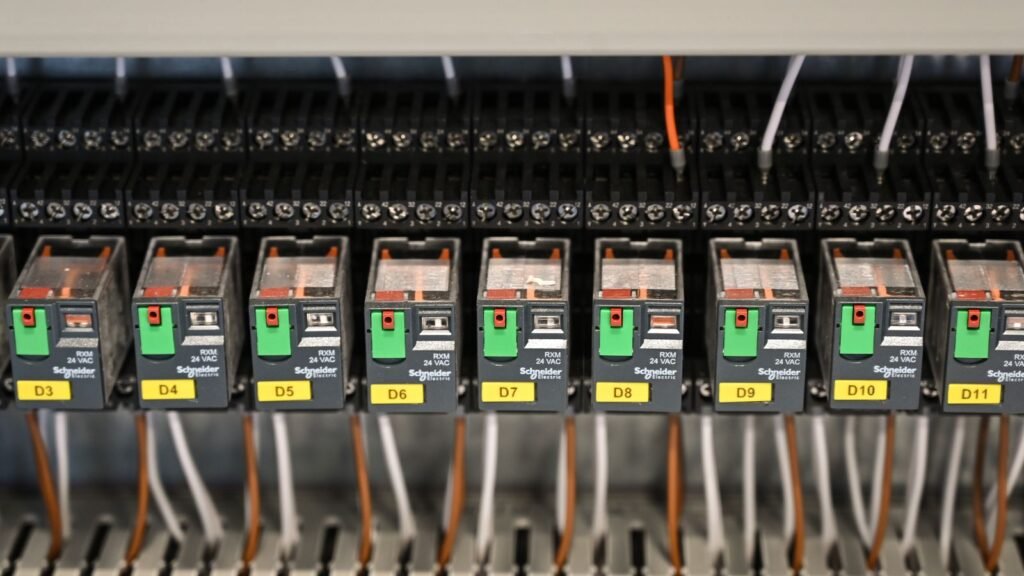

Industrial AI is moving from general advice into the automation-engineering workflow. For plant managers, machine builders, controls engineers and technical procurement teams, that creates a practical question: what must be specified before AI-generated PLC logic is allowed anywhere near a real machine?
On 27 August 2026, Siemens launched its Eigen Engineering Agent in Thailand. Siemens says the system works with TIA Portal and can support PLC coding, HMI visualisation, device configuration, ECAD integration and project generation. The announcement is commercially important across Southeast Asia because it shows that AI-assisted automation engineering is moving closer to everyday controls work—not merely producing documentation or chat responses. Siemens press release
The opportunity is faster engineering. The buyer risk is accepting code, tags or device configurations without an equally disciplined process for functional requirements, field signals, failure behaviour, validation and change control.
Planning an AI-assisted controls or brownfield I/O project? Tachyonic Intelligence can help define the machine signals, I/O architecture, communications, local behaviour and commissioning inputs before implementation begins.
Why the Thailand launch matters to automation buyers
Siemens positions its agent as a system that can plan, execute and validate automation-engineering tasks using project context. It says the tool can read electrical-design data, detect inconsistencies, create PLC tags and generate projects using its own automation framework. Siemens also reports deployment by more than 100 companies in 19 countries and publishes substantial productivity and quality improvements. Those performance figures are vendor claims and should be validated against each buyer’s own project type, engineering baseline and acceptance criteria.
The wider market signal is more important than one product: automation buyers should prepare for engineering deliverables that are partly generated, transformed or checked by AI. Procurement specifications now need to cover not only hardware, programming languages and commissioning, but also traceability, review authority, test evidence and ownership of generated work.
What industrial AI can accelerate—and what it cannot own
AI can be useful for repetitive engineering work: generating structured code from an approved functional description, creating tags from electrical data, producing HMI objects, identifying inconsistencies, drafting tests and explaining an unfamiliar project. These are valuable tasks when the source information is controlled.
AI cannot determine an undocumented machine’s safe behaviour by inference alone. It does not automatically know whether a sensor is PNP or NPN, whether an output is sourcing or sinking, whether a solenoid requires a defined communications-loss state, whether a reset may restart motion, or whether a safety function is independent of standard control. Those decisions belong to the responsible engineering and safety process.
IEC 61131-3:2025 defines the syntax and semantics of programmable-controller languages including Structured Text, Ladder Diagram, Function Block Diagram and Sequential Function Chart. Conforming language structure is necessary, but it does not prove that a machine sequence is correct for the application.
Eight controls buyers should specify before deployment
1. Start from an approved functional specification
Describe the machine states, permissives, interlocks, alarms, operator actions, timers, setpoints, recovery paths and abnormal conditions before generating code. If the source specification is ambiguous, AI can produce polished ambiguity faster.
2. Freeze the field-I/O definition
Document every signal’s electrical type, normal state, failure state, terminal reference, scaling, filtering, update rate and ownership. For digital I/O, procurement should confirm dry contact versus powered signal, PNP/NPN compatibility, output load, protection, pulse frequency and wiring convention. The AI project must reflect the electrical drawing—not replace it.
3. Keep safety functions within the assessed safety lifecycle
Standard PLC logic, AI recommendations and safety-related control must be separated according to the application risk assessment. An AI tool should not be treated as authority to redesign emergency stops, guards, safe torque-off functions or protective trips without the required competent review and validation.
4. Require traceability and version control
Every generated change should identify the source requirement, affected blocks, reviewer, test case and approved release. Buyers should be able to reproduce the project from controlled source files and determine exactly what changed between versions.
5. Simulate before downloading to equipment
Use an offline project, digital twin, software simulation or test panel to exercise normal and abnormal sequences. Testing should include contradictory inputs, invalid values, stuck sensors, excessive pulse rates, missing devices and unexpected operator actions—not only the intended production cycle.
6. Test startup, reset and communications loss
Define outputs during power-up, controller restart, network interruption and recovery. A communications-loss safe state is an application decision: some loads should de-energise, some should hold, and others require a controlled local sequence. The correct behaviour must be deliberately engineered and verified.
7. Secure the engineering environment
Control who can access source projects, electrical files, libraries, device configurations and production controllers. The ISA/IEC 62443 series addresses cybersecurity robustness and resilience across the industrial-automation and control-system lifecycle; AI-assisted engineering should fit within that lifecycle rather than bypass it.
8. Define lifecycle ownership
State who owns the code, prompts, libraries, generated artefacts, test records, backups and future modifications. Procurement should also define what happens when the AI service, engineering software, model or subscription changes.
Mid-project checklist: provide the current PLC or IPC, protocol, electrical drawing, signal types, I/O count, output loads, required sequence, failure behaviour, installation environment and target date. Tachyonic can use these inputs to help scope the field-I/O and edge-control architecture.
Field I/O is where generated logic becomes physical action
An AI engineering tool may produce a logically consistent program, but the real machine depends on electrical compatibility and deterministic behaviour at the field layer. Remote I/O selection therefore remains a core engineering task.
Tachyonic Intelligence’s Titania Super I/O family is designed for distributed industrial I/O with configurable local logic, sequencing, alarm behaviour, output shaping and deterministic power-up or communications-loss states. Typical applications include PLC and IPC expansion, production counting, proximity and limit switches, local interlocks, valve or solenoid sequences, and annunciation. Final suitability depends on the selected variant, signal type, electrical load, protocol, environment and required local autonomy.
This is the honest connection to the Thailand development: Tachyonic Intelligence does not claim to supply the Siemens AI agent or to be affiliated with Siemens. It can help buyers define and integrate the industrial signals and field behaviour that any PLC-engineering workflow—manual or AI-assisted—must implement correctly.
A practical first pilot
Choose one bounded machine or subsystem with a controlled electrical drawing and measurable engineering workload. Suitable pilots may include a production counter, alarm annunciator, valve sequence, cabinet I/O expansion or a legacy machine whose states are already understood.
Freeze the baseline project, define acceptance tests, allow AI to assist only within the agreed scope, and require an engineer to review every change before simulation and commissioning. Compare engineering time, defect findings, rework and documentation quality against the established baseline. Do not extrapolate a vendor productivity figure directly into a purchasing case.
NIST’s 2026 concept note for trustworthy AI in critical infrastructure emphasises repeatable lifecycle risk management, tested and validated guardrails, traceability and human oversight for AI-enabled systems. That is a useful procurement posture even when the immediate application is a factory machine rather than national critical infrastructure. NIST concept note
The buying decision is a governance decision
Industrial AI can reduce repetitive automation work and help engineers understand large projects. Its value depends on the quality of the specifications, data, libraries, reviews and tests around it.
Before buying an AI engineering subscription or commissioning an AI-assisted project, require a clear answer to four questions: what information the system may use, what outputs it may create, who approves those outputs, and how the result will be validated on the actual electrical and mechanical system.
Define the field architecture before implementation
Share your company and industry, machine or subsystem, current controller and protocol, signal types and I/O count, output loads, operating pain point, installation location, quantity and target date. Tachyonic Intelligence can help identify the I/O, communications, local-behaviour and commissioning questions that must be resolved.
Sources
Siemens: Eigen Engineering Agent launch in Thailand — published and launched 27 August 2026. Vendor source for product capabilities, availability and reported adoption outcomes.
IEC 61131-3:2025 — published 22 May 2025. Official standard page for programmable-controller language syntax and semantics.
ISA/IEC 62443 series — checked 30 August 2026. Official ISA overview of industrial-automation and control-system cybersecurity lifecycle requirements.
NIST AI RMF critical-infrastructure concept note — issued 7 April 2026. Official source for lifecycle risk-management, trustworthiness and human-oversight considerations.
Tachyonic Intelligence: Titania Super I/O family and Solutions — checked 30 August 2026. Sources for the Tachyonic capability statements.