
Industrial predictive maintenance is moving closer to the machine. Recent industry developments point in the same direction: process the signals that need fast, local interpretation at the edge, then send compact condition information upstream for maintenance decisions.
On 28 August 2026, Mining Weekly reported how continuous monitoring of motors, gear units and other rotating equipment can give maintenance teams earlier visibility into developing problems. Qualcomm has likewise highlighted industrial edge AI as a way to turn machine data into local insights while reducing dependence on continuous cloud connectivity. For buyers, the useful question is not simply where can we put AI? It is which decisions should happen at the machine, and which data should go to PLC, SCADA, historian or cloud?
Planning a motor, pump, fan, compressor or gearbox monitoring project? Tachyonic Intelligence can review the asset, operating speed, likely failure modes, existing controls and required integration before you select the monitoring architecture.
Why edge processing is becoming important for predictive maintenance
Vibration monitoring can produce far more information than a maintenance system needs continuously. Raw acceleration waveforms, spectra, harmonics, temperature, speed context and derived condition indicators each serve different purposes. Moving every sample to a central platform can increase network, storage and engineering overhead without necessarily improving the maintenance response.
Edge processing changes the architecture. A sensor or nearby edge device can calculate useful condition indicators close to the asset. The supervisory system can then consume trends, severity states and selected diagnostic information rather than treating every machine as a continuous raw-data stream.
Three layers of a practical industrial architecture
1. At the machine: measurement and first-stage interpretation
The machine layer should handle measurements that depend on timely acquisition and consistent signal processing. For rotating equipment this can include vibration acceleration, velocity and displacement, temperature, harmonic information and other configured condition indicators.
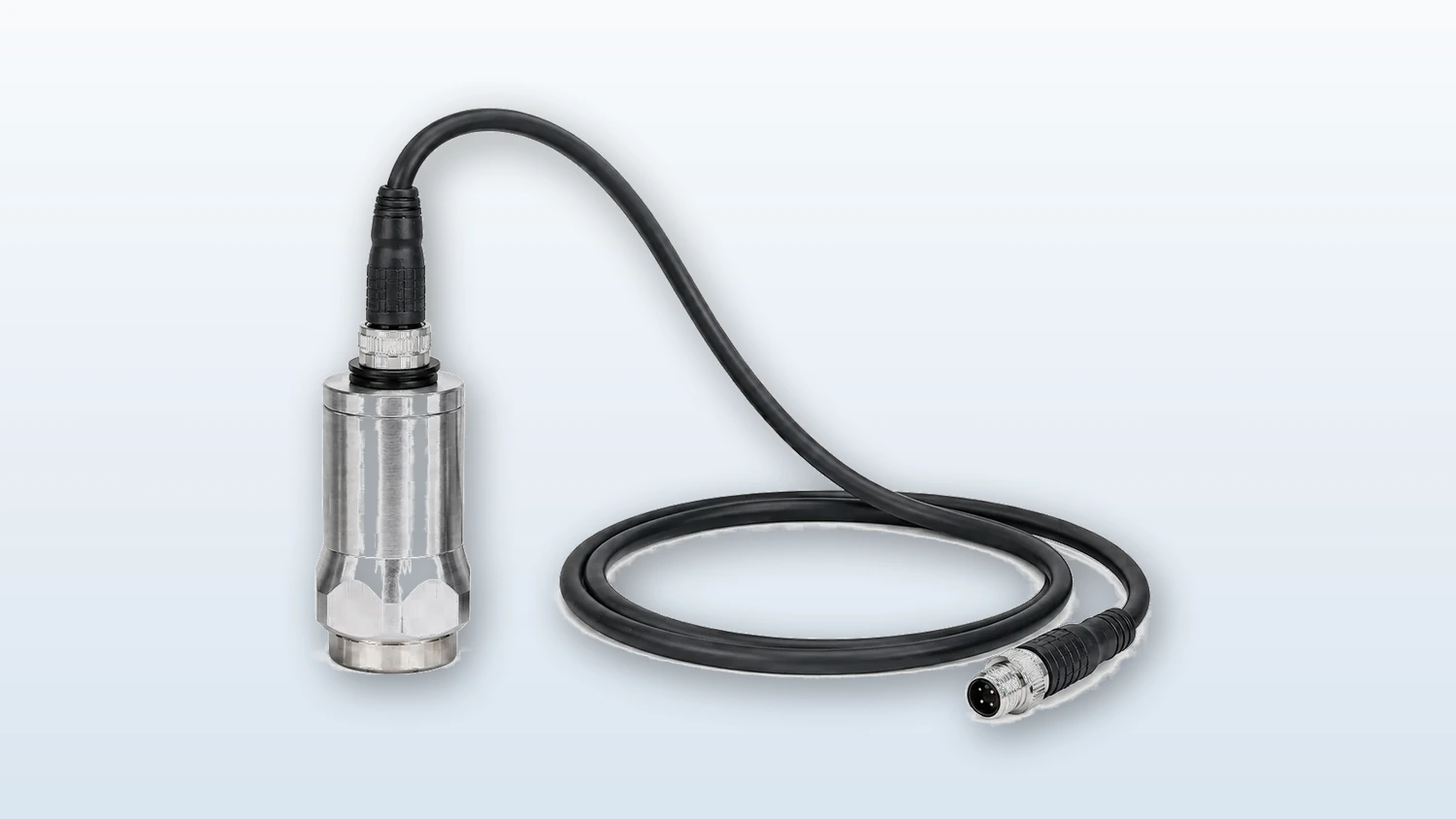
Tachyonic Intelligence’s PyXis smart 3-axis vibration sensor is designed around this approach. The current Rev 08 datasheet describes edge processing of vibration and temperature information and the publication of compact condition and prognostic information over RS-485 Modbus RTU, without requiring continuous transport of raw waveforms.
2. At the PLC, gateway or plant network: context and coordination
Machine condition becomes more useful when it is combined with operating context. Speed, load, valve state, process flow, production state and maintenance history can help distinguish a genuine deterioration trend from a normal operating transition.
This is also where brownfield integration matters. An existing PLC or SCADA system may already be the right place to collect Modbus condition registers, timestamp alarms, associate them with the asset and route information to operators or historians.
3. At the analytics or maintenance layer: fleet decisions
Central systems remain valuable for comparing many assets, retaining long-term trends, planning maintenance and applying models that benefit from fleet-level data. Edge AI does not eliminate the cloud or plant server; it can reduce the amount of low-value data that has to travel there.
What should stay local?
| Information or decision | Likely location | Reason |
|---|---|---|
| Sensor acquisition and basic signal processing | Sensor / machine edge | Consistent timing and lower data movement |
| Overall condition indicators and fault states | Sensor or edge device | Compact values are easy to integrate and trend |
| Machine speed, process state and permissives | PLC / local controller | The controller already knows operating context |
| Long-term fleet comparison | Historian / maintenance platform | Needs data from multiple assets and longer periods |
| Maintenance work planning | CMMS / engineering workflow | Requires people, history, spares and scheduling context |
Where edge AI adds value—and where it does not
Edge AI is most useful when local inference produces a decision that is faster, more resilient or more economical than continuously sending raw data elsewhere. It can also be useful where operational data should remain on site.
But AI should not be added merely because an edge processor can run a model. For many assets, engineered thresholds, vibration trends, harmonics and operating-state logic may solve the maintenance problem more transparently. A good architecture starts with the failure mode and required maintenance action, then chooses the simplest analysis that reliably supports that decision.
A buyer checklist before deploying predictive maintenance
- Which motors, pumps, fans, compressors, gearboxes or conveyors are economically important?
- Which failure modes are you trying to detect?
- What are the normal speed and load ranges?
- Do you need continuous monitoring or periodic diagnostic capture?
- What PLC, SCADA, historian or CMMS already exists?
- Can existing RS-485 / Modbus infrastructure be reused?
- Who receives an abnormal-condition alert and what action follows?
- What evidence will be used to validate alarms during commissioning?
Start with one measurable maintenance problem
Current industrial AI discussion increasingly emphasizes operational outcomes rather than AI for its own sake. A sensible pilot therefore starts with a contained group of assets and a defined maintenance question. Establish healthy baselines, capture operating context, validate abnormal indications and confirm that the alert reaches somebody who can act on it.
Only then should the architecture be expanded across a fleet.
Discuss an application with Tachyonic Intelligence
Send the machine type, rated power, normal RPM or speed range, known failure history, existing controller/protocol, number of monitoring points, installation environment and target date. We can help define the measurement and integration scope before product selection.
Sources and technical notes
- Mining Weekly: Early detection helps reduce unplanned downtime — 28 August 2026.
- Qualcomm: Edge AI ignites the next industrial revolution — 20 August 2026.
- Tachyonic Intelligence PyXis product page — checked 28 August 2026.
- PyXis 222x Series Datasheet TTN-DS-2026-002 Rev 08 — issued 22 July 2026.
Fact-check note: External industry statements are attributed to their publishers. No external vendor performance is presented as a PyXis specification. PyXis capability statements are limited to Tachyonic’s current public product information and controlled Rev 08 datasheet. Actual fault interpretation depends on machine configuration, mounting, operating state, baseline and commissioning.