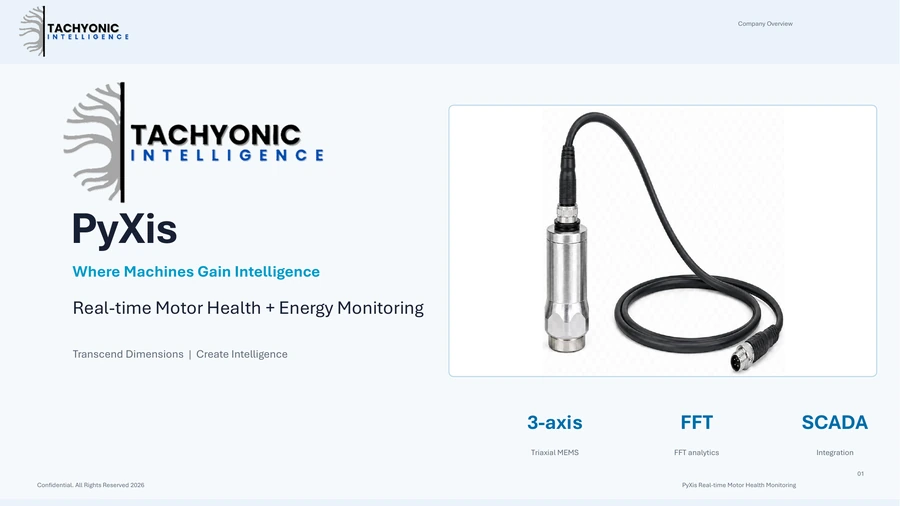
3-axis MEMS vibration sensing
Captures vibration in X, Y and Z for a more complete view of machine condition.
Real-time motor health monitoring
Where Machines Gain Intelligence
PyXis processes triaxial vibration and temperature at the machine, delivering motion metrics, harmonic information, severity states, alarms and firmware-dependent prognostic values directly to connected control and maintenance systems.
Professional machine-health insight
Small vibration changes can appear early in the failure curve. PyXis helps teams observe those changes while intervention remains practical.
Early warning for critical rotating assets.
Protect uptime, output and maintenance visibility.
Captures vibration in X, Y and Z for a more complete view of machine condition.
Provides up to 20 harmonic frequencies and acceleration amplitudes per axis without transmitting the raw waveform.
Provides severity, fault status, order information, diagnostic indices and firmware-dependent prognostic outputs.
Supports detection of misalignment, unbalance, looseness, gear wear and bearing-related patterns.
Exposes device identity, vibration, temperature, alarms and machine-health values over 2-wire RS-485 Modbus RTU.
Sealed IP67 / IP68 construction, wide DC supply range, low power consumption and M12 or integral-cable options.
Motor degradation and the P-F curve
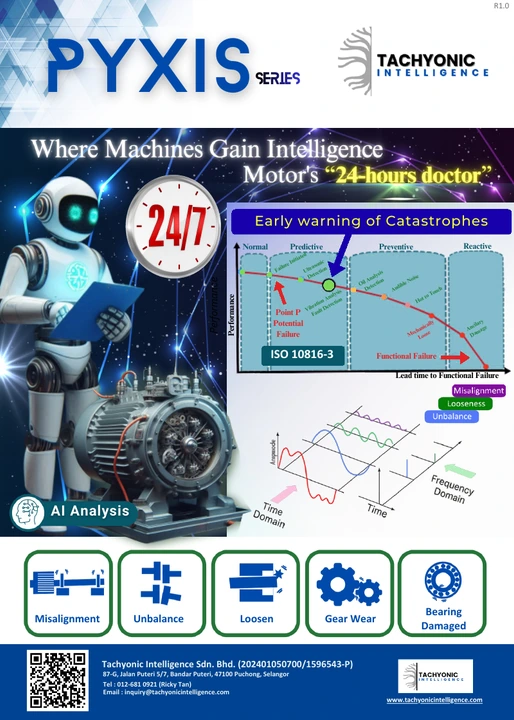
The P-F curve links the progression of motor deterioration with the vibration indicators that become visible at each stage.
 Enlarge diagram
A motor can progress from a healthy baseline through early high-frequency stress-wave activity, bearing or lubrication degradation, mechanical fault growth and finally functional failure. Waveforms and FFT spectra become progressively more abnormal as impacts, bearing frequencies, harmonics and broadband vibration increase.
PyXis combines high-frequency stress-wave detection, triaxial vibration and FFT analysis to reveal early bearing signatures and developing faults. Earlier recognition gives maintenance teams more time to verify the condition, plan intervention and avoid run-to-failure maintenance.
Engineering illustration: the actual P-F interval and fault signature depend on speed, load, bearing geometry, sensor mounting, operating state, baseline quality, analysis settings and firmware profile.
Motor fault coverage
The exploded motor view maps common fault sources to the physical components where they develop, helping maintenance teams relate PyXis condition data to practical inspection points.
 Enlarge diagram
The guide highlights outer-race and inner-race bearing faults, rolling-element defects, misalignment, rotor eccentricity, rotor-bar or electrical abnormalities, shaft imbalance, bent shaft, cooling-fan faults and mechanical or mounting looseness.
PyXis combines triaxial vibration, waveform and FFT information, bearing-frequency patterns, harmonics and condition trends to support earlier recognition and maintenance prioritisation. Findings should be checked against machine speed, load, bearing geometry, mounting quality and operating history.
Diagnostic guide: detectability and confidence vary with sensor location, installation quality, machine construction, operating state, baseline quality, analysis settings and firmware profile.
Product capabilities
PyXis turns high-bandwidth vibration and temperature measurements into compact condition, diagnostic and prognostic information that industrial systems can use directly.
Fault interpretation depends on installation, machine configuration, operating state and firmware profile. Final alarm limits should be commissioned for the actual asset.
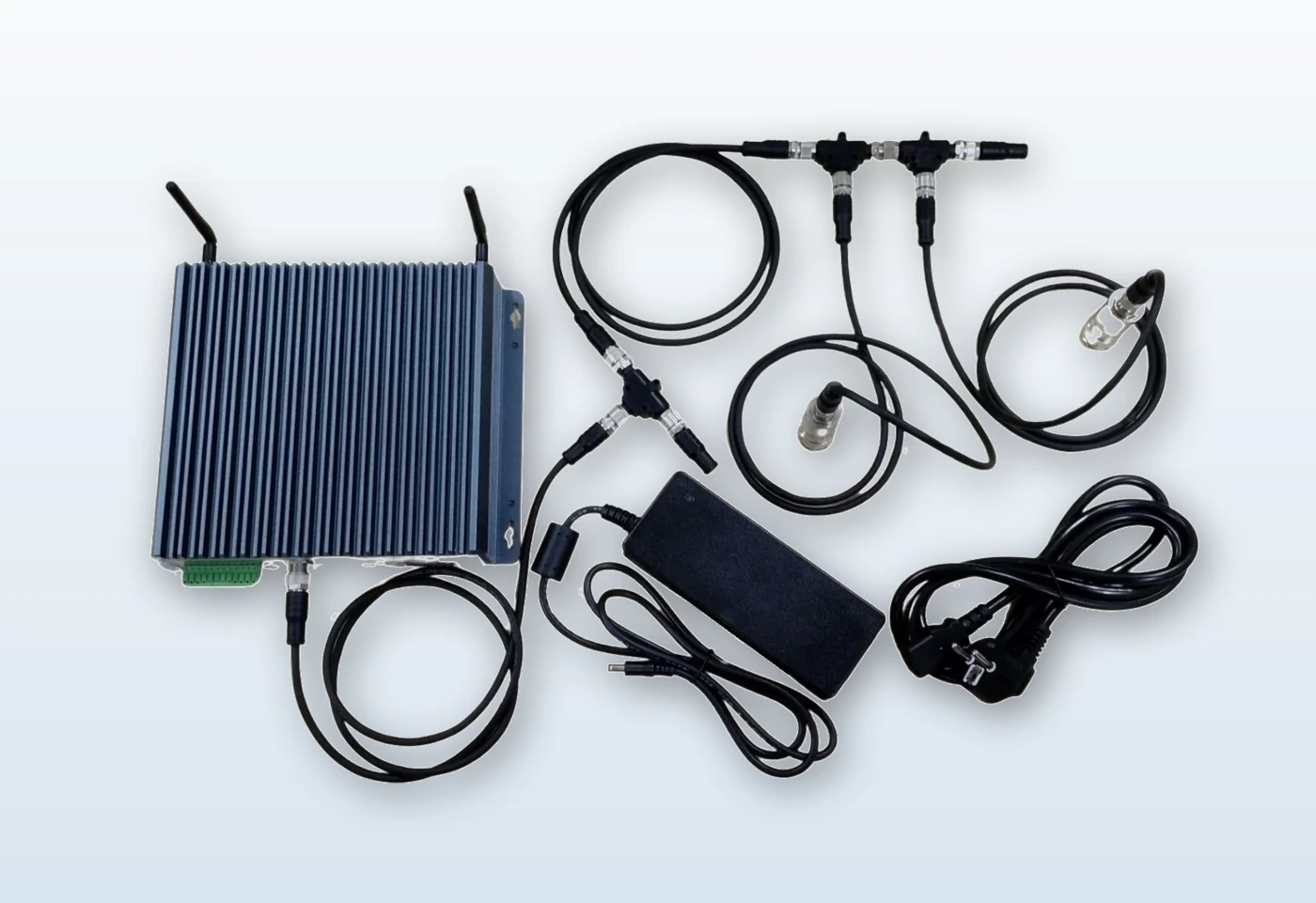 Complete multi-sensor monitoring system
System overview
Technical overview
Confirm final specifications and model applicability against the latest controlled product documentation before design or procurement.
Advanced diagnostic and prognostic items are firmware-dependent. Verify the applicable firmware and register-map revision before system integration.
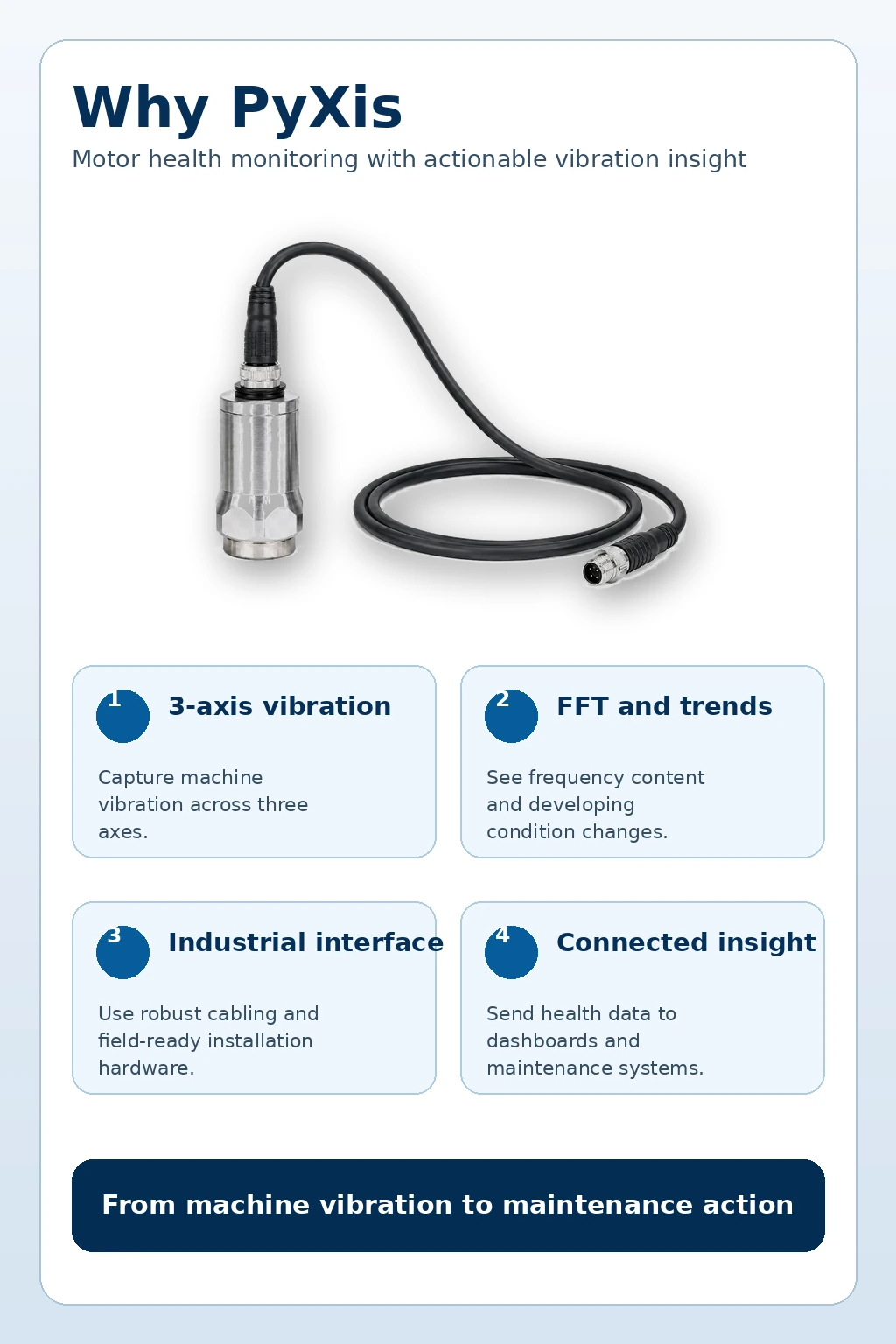
Why PyXis stands out
PyXis is presented as a complete monitoring solution: sensing, spectrum analysis, machine-health insight and industrial integration in one workflow.
Downloads
Open the controlled four-page datasheet, the technical presentation and the product brochure.
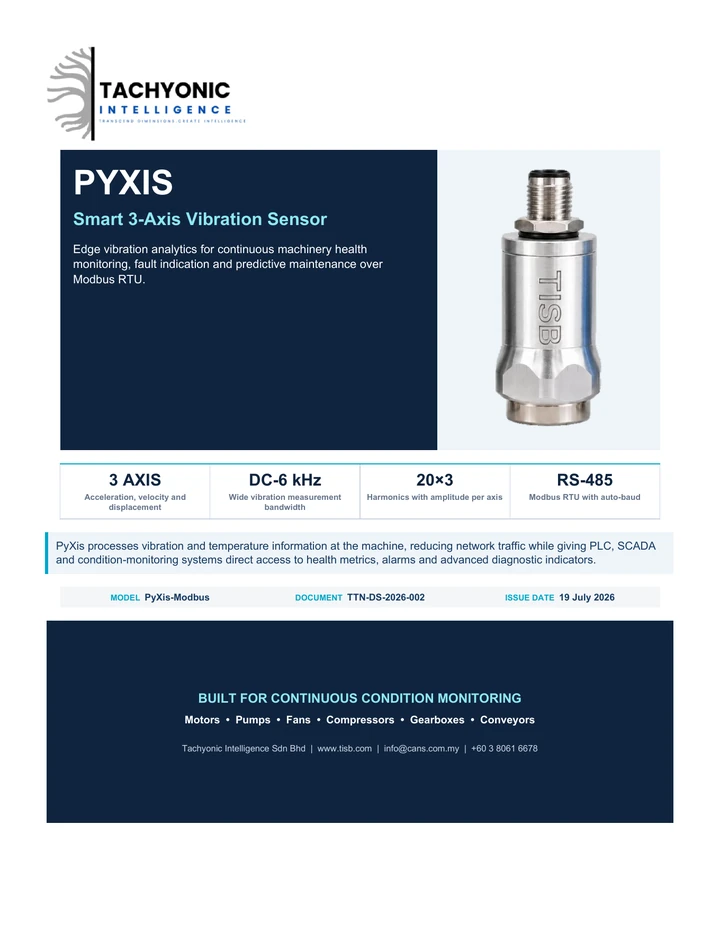
PyXis is a smart three-axis vibration sensor for continuous machinery health monitoring, fault indication and predictive-maintenance workflows. It measures acceleration, velocity and displacement independently on X, Y and Z and processes vibration locally so supervisory systems receive compact condition information rather than large raw time-waveform streams.
Available values include acceleration RMS, peak and peak-to-peak, crest factor, velocity RMS and peak-to-peak, displacement peak-to-peak, up to twenty harmonic frequencies with corresponding acceleration amplitudes for each axis, per-axis severity and fault states, RPM, tachometer quality, speed state and 1X order information.
Firmware profiles may expose envelope kurtosis, sideband density, harmonic consistency, cepstrum gear index, spectral kurtosis and cyclostationary index. Prognostic values can include Remaining Useful Life in days, failure probability, degradation index, time-to-maintenance, baseline status and aging factor. These outputs must be interpreted together with machine configuration, operating state and maintenance history.
The sensor communicates as a Modbus RTU slave over two-wire half-duplex RS-485. Supported settings include slave ID 1-247, auto-baud or 9600, 19200, 38400 and 115200 bps, even, odd or no parity, configurable stop bits and a 0-50 ms response delay. Device identity, system-management commands, vibration values, spectral data, condition states, alarms and machine-profile settings are available through the controlled register map.
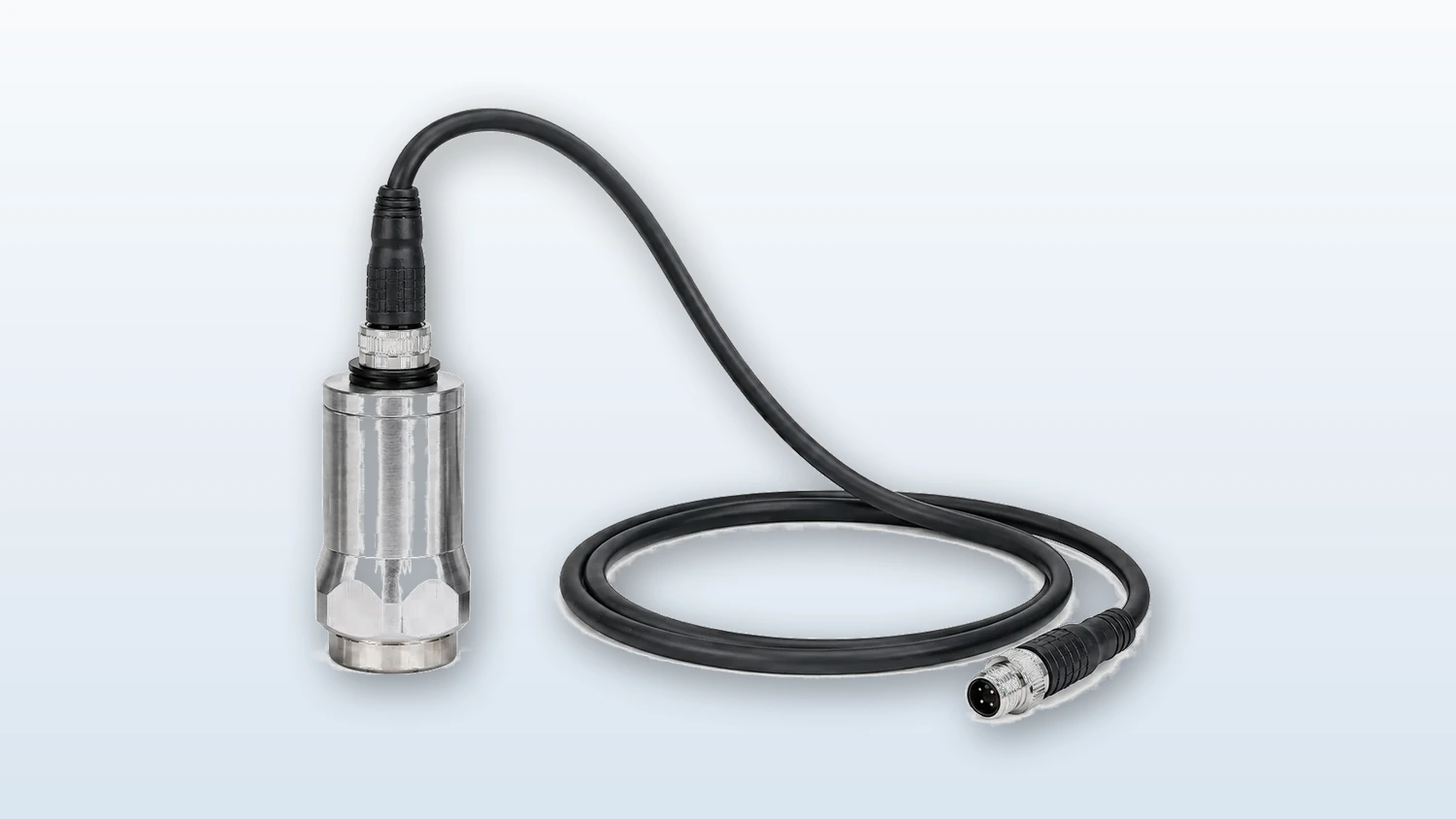
PyXis operates from 4.75 to 28 VDC with less than 0.15 W typical consumption, uses an A-coded M12 five-pin male connector or high-flex integral cable option, and supports M5 stud or high-force magnetic mounting. Sealed construction is rated IP67/IP68 subject to the selected connector and installation method. Specify the connection version, mounting accessories, required cable length, firmware profile and target machine type when ordering.
Controlled-document note: verify document TTN-DS-2026-002, the applicable firmware profile and the register-map revision before design or integration. Final alarm limits must be commissioned for the actual machine.
Technology insights
Practical guidance derived from the current PyXis and Titania technical material.
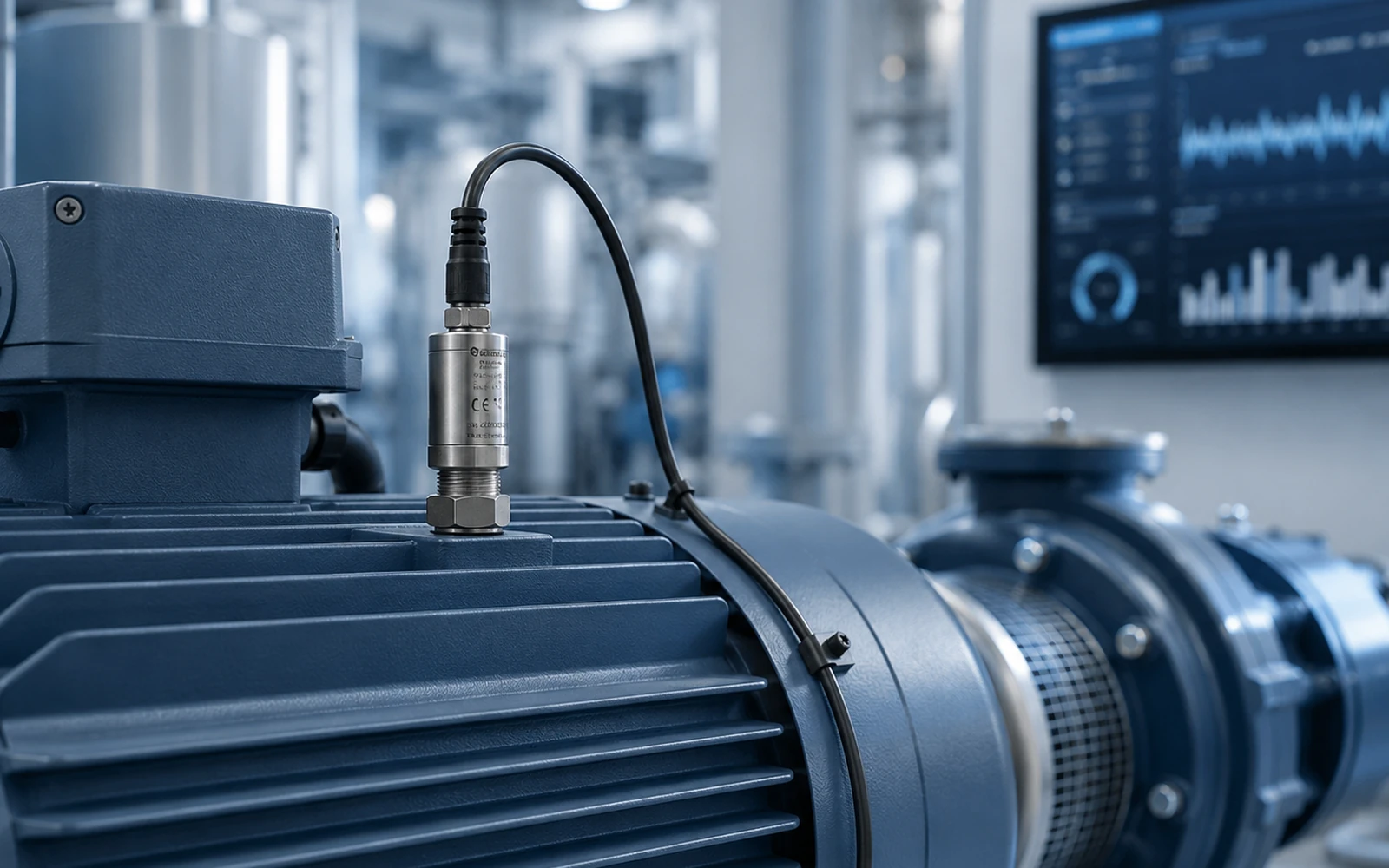
Technology article
How machine-level vibration processing turns triaxial motion, spectral information and temperature into practical condition intelligence.
Read more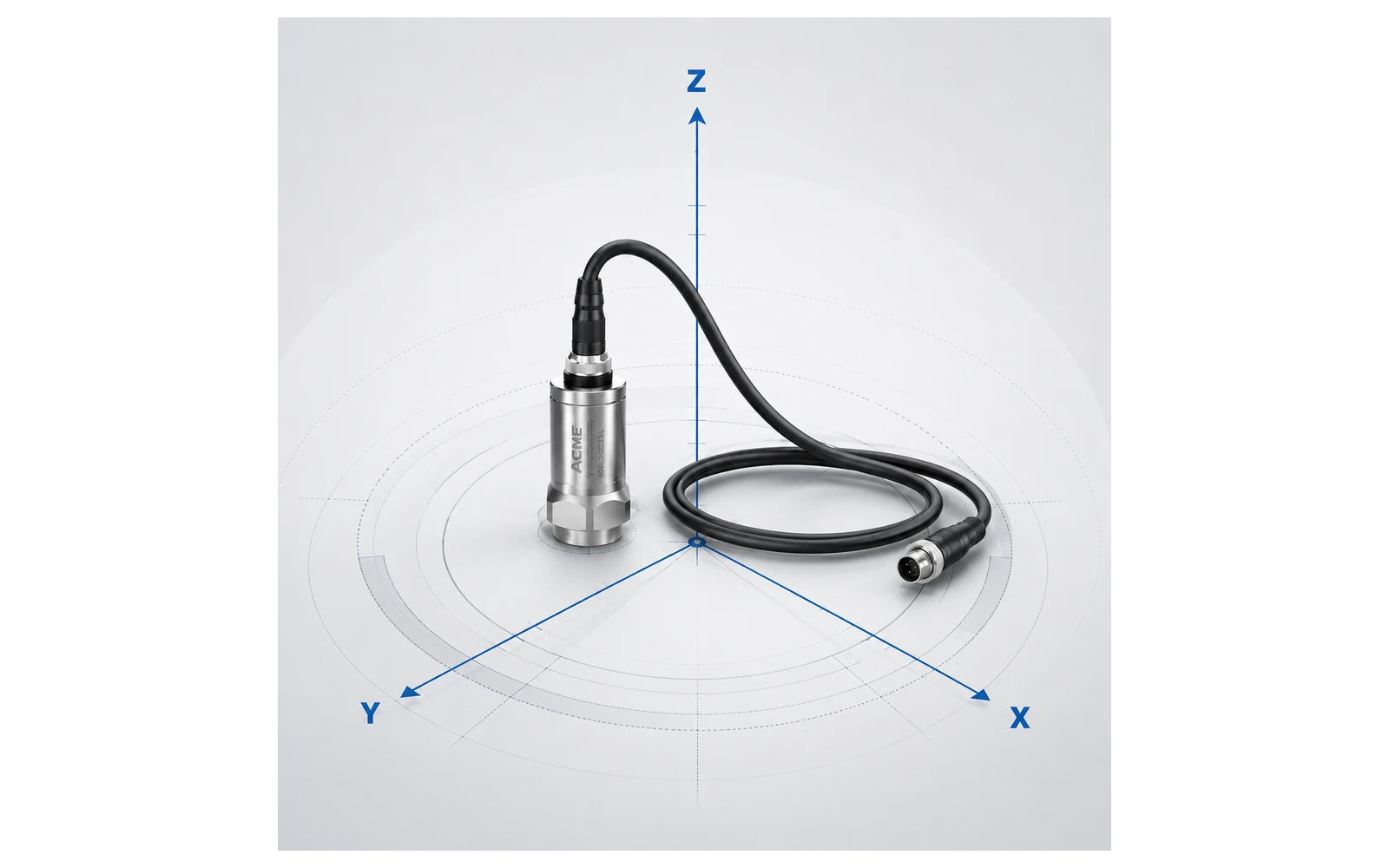
Technology article
A practical guide to the three motion quantities used in industrial condition monitoring and how they complement one another.
Read more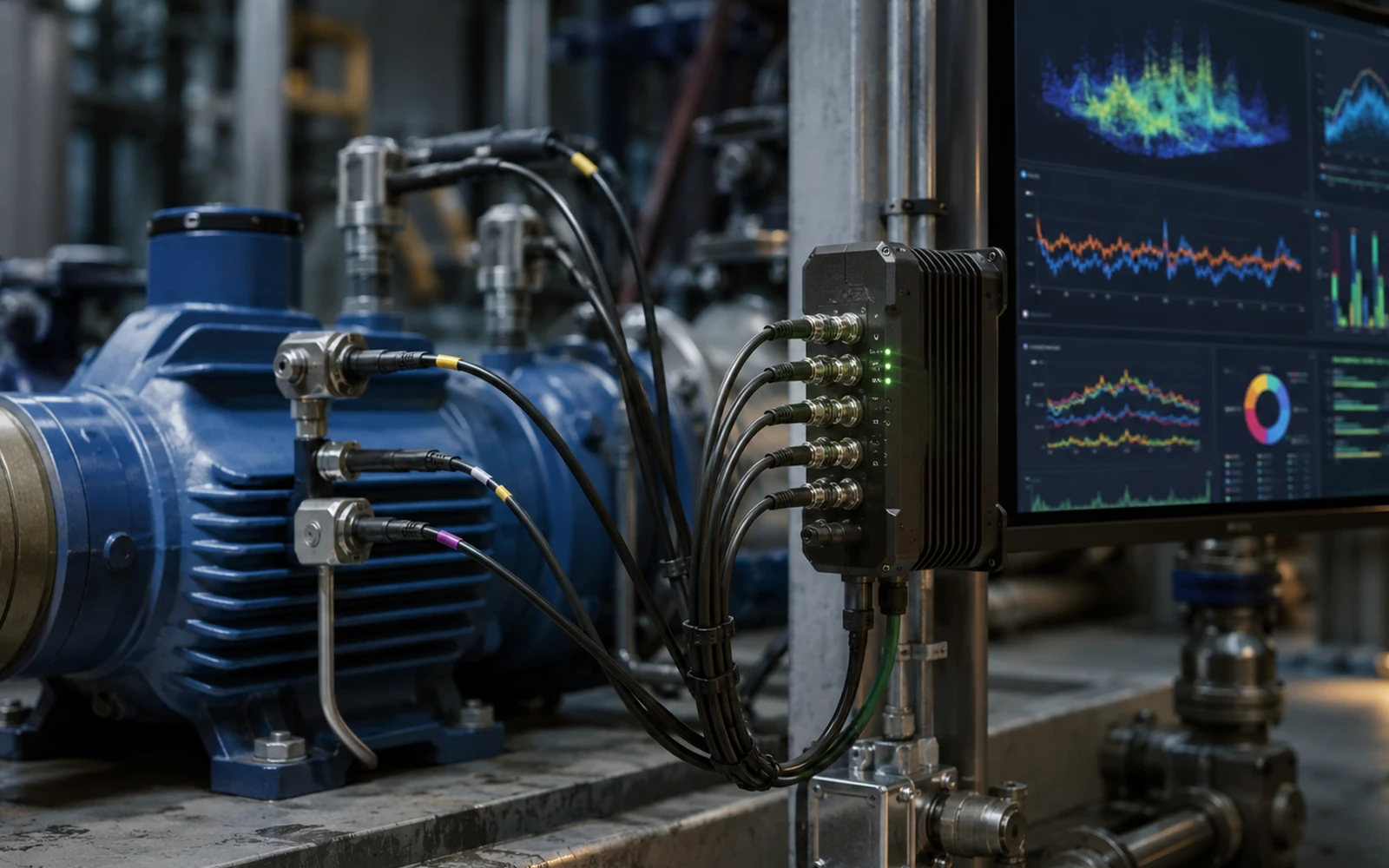
Technology article
How RPM, 1X order information and harmonic amplitudes improve vibration interpretation on variable-speed and geared equipment.
Read more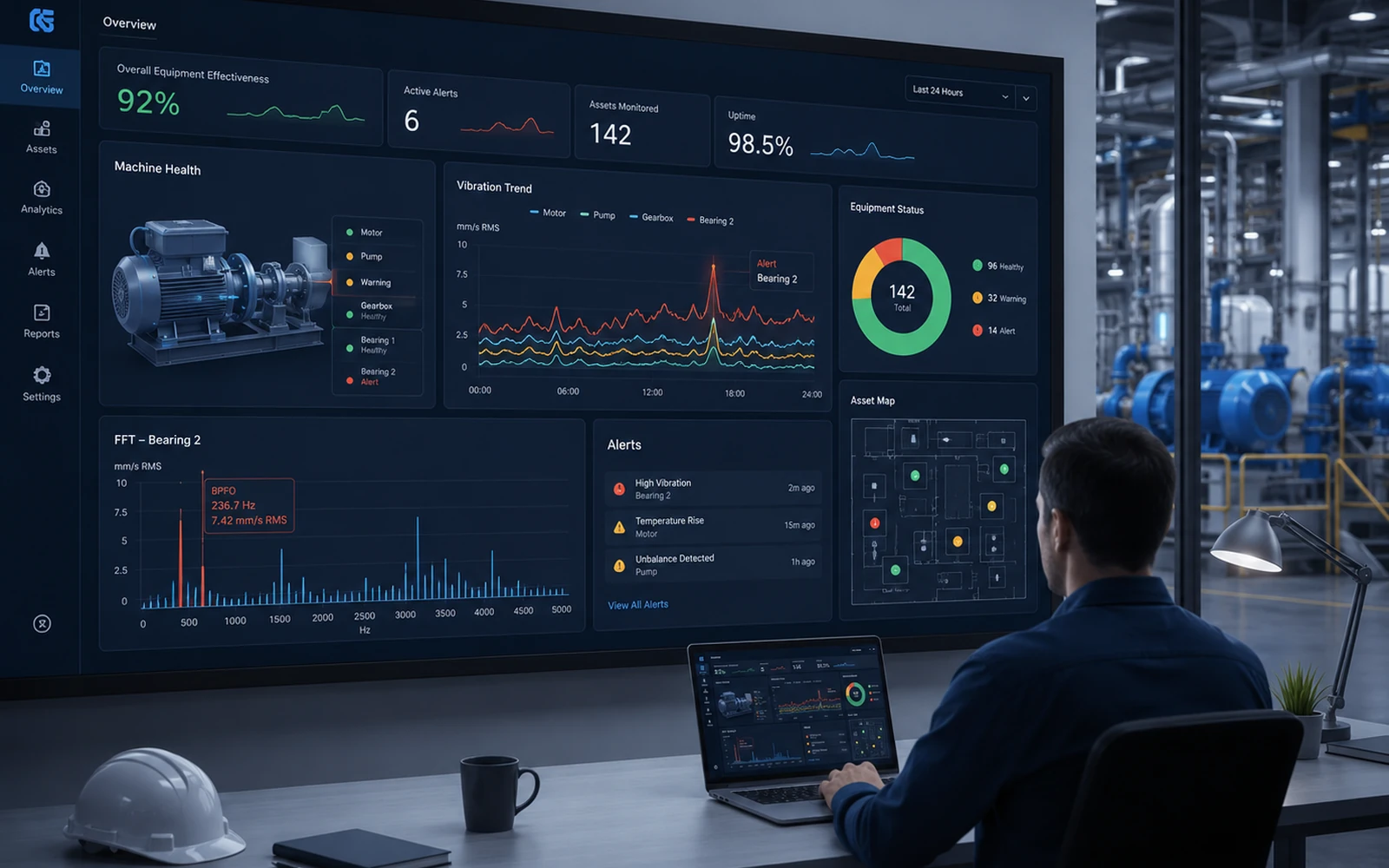
Technology article
A professional overview of envelope kurtosis, sideband density, harmonic consistency, cepstrum, spectral kurtosis and cyclostationary analysis.
Read more
Technology article
How to establish representative healthy behaviour and set warning and alarm limits that support maintenance without creating nuisance events.
Read more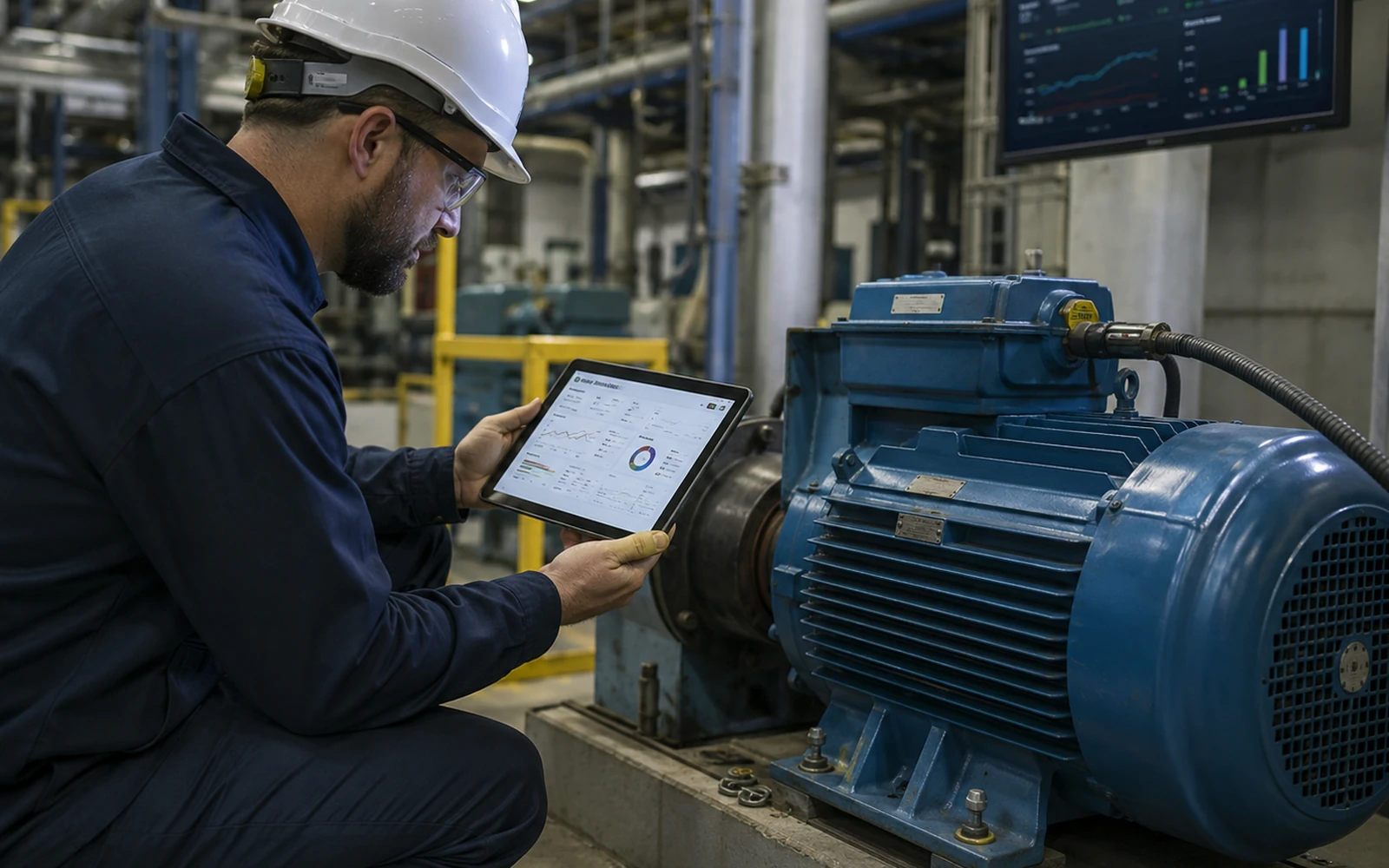
Technology article
Practical guidance for stud and magnetic installation, cable routing and triaxial orientation on industrial machinery.
Read moreDiscuss your application
Review sensor count, machine type, communications, installation points and integration requirements with our team.